



1-855-602-7447
Experts available 7 days a week!



Hotels & Resort Deals
Select a destination...
 View All Hotels & Resort Deals
Vacation Interests
Miscellaneous
Tours By Type
Tour Deals
Select a destination...
 View All Tour Deals
Cruises From
Vacation Interests
Career Discounts
Featured Destinations
Select a destination for info and deals...
Destination Ports
Cruises sailing in each region...
- Transfer Your Booking To Us
- Book Shore Excursions
- Book Land Tours
- Save on Passport & Visa Services
-
![Arrow]() View All Customer Service Resources
View All Customer Service Resources
Saving Tools
- Access Reservation (web-made bookings only)
- Make a Payment
- Add Travel Insurance
- Pre-Cruise Registration
For Existing Reservations
- Land Vacation FAQs
- Cruise FAQs
- Cruise Port Directions
- Contact Us
Useful Links


Highlights Of The Trans Bhutan Trail

-
Length
12 Days
-
Quality
This indicates the overall quality of the tour operator's products. A low rating does not mean it is not good - it just means that it does not include as much, or perhaps is of a more standard quality than the higher quality tours. For example, a 3 star quality rating means that it is a more standard/economical tour, while 5 stars is a very luxurious tour that often includes a lot of amenities. -
Starts in
Paro (Bhutan)
-
Ends in
Paro (Bhutan)
-
Available Tour Start Dates
SEP 13, 2026 to NOV 30, 2028
-
Activity Level
Challenging
-
Style
Fully-Guided
-
Guaranteed Date(s)
Yes means that there is at least one tour date that the vendor guarantees will occur. No means that there is not at least one tour date that the vendor guarantees will occur, which usually means that the vendor wants a certain amount of reservations on each tour in order for each one to occur. Of course, the terms and conditions of the vendor do allow for the vendor to cancel guaranteed tour dates for certain reasons (for example, a natural disaster).Yes
-
Special Interest(s)
Active
Hiking, trekking, biking, rafting, and kayaking adventures all over the world, made for outdoor types., Small GroupGroup trips average 12 travellers per departure, depending on the adventure. The maximum is usually no more than 16, but some can be smaller or bigger, depending on the trip. Check individual trips for details.
From
Pricing listed is per person, based on double occupancy, and is the least expensive price for at least one departure date of this tour. Price is for the tour only. Additional items, including but not limited to, airfare (unless noted otherwise), travel insurance, and more, are additional.
$5,249.00
Contact Us for a Special Price!
Overview
Imagine exploring the happiest country on Earth while walking along the same path used by royals, monks, and traders for thousands of years. That's the Trans Bhutan Trail. Until the 1960s, it was the only way to get around the mountain kingdom of Bhutan. And now, for the first time in 60 years, you can hike it yourself. On this 12-day tour, you'll travel and trek along the best portions of this historic trail, using your own two feet to experience rural and spiritual life in the most beautiful parts of the country. Venturing from west to east, you'll hike along high mountain passes, across lush river valleys, and through villages from a different era, stopping to soak in local history, culture, and customs along the way. There really is magic on the Trans Bhutan Trail, and it's ready to be rediscovered.
Visited During Tour
Chendebi (Bhutan) | Jakar (Bhutan) | Paro (Bhutan) | Punakha (Bhutan) | Thimphu (Bhutan) | Trongsa (Bhutan) | Ura (Bhutan)
Dates, Offers & Prices
Tour Itinerary
Accommodations
More Details
Dates, Offers & Prices
The following are Highlights Of The Trans Bhutan Trail tour dates available from G Adventures. Select a bonus offer graphic to view its details, including its terms.
There is at least one departure that the vendor is advising is Not Available for the selected year. Click here if you would like such tours to be included below.


Tour Itinerary
G Adventures Tour Code ADTP-11589
-
Day
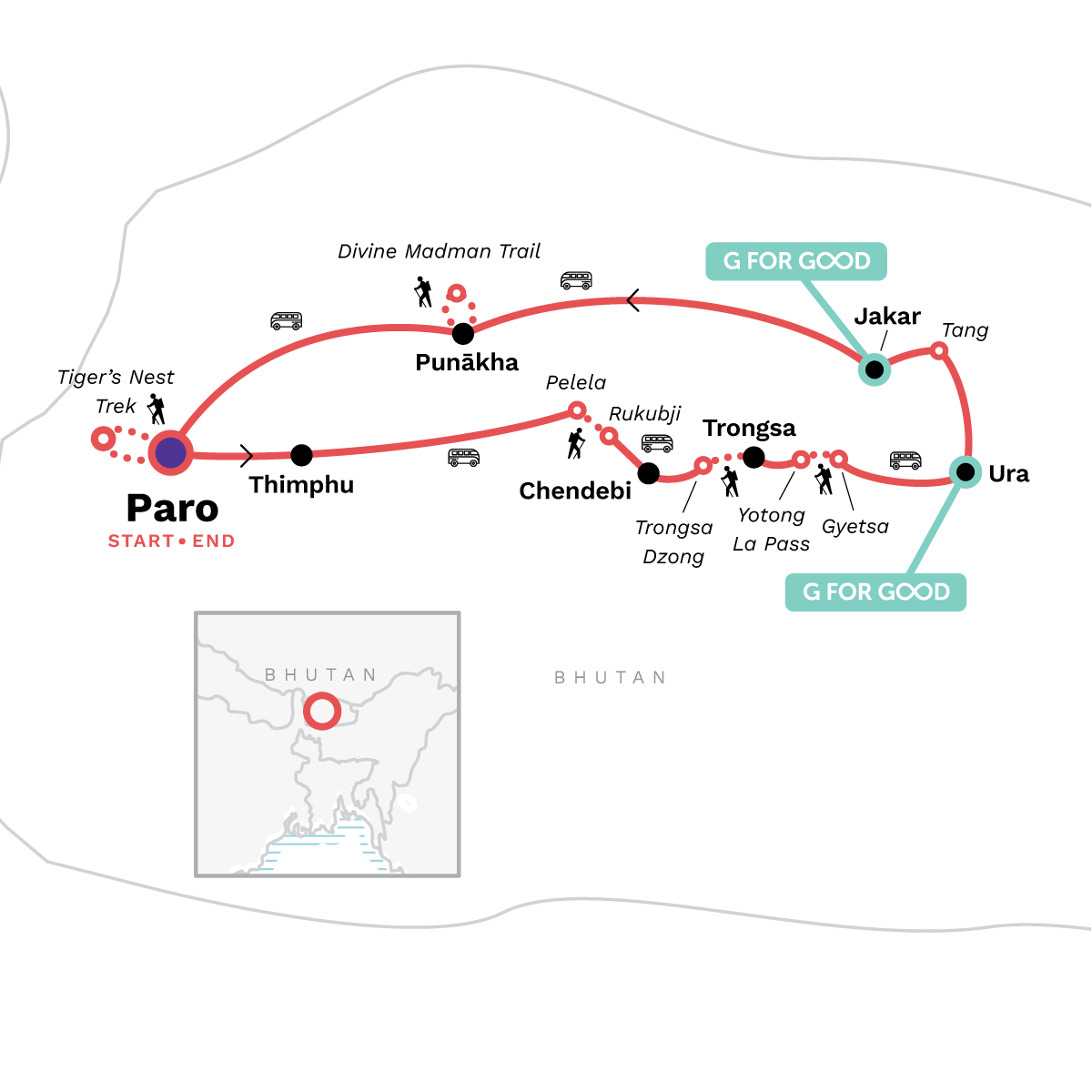
1Paro/Thimphu
Upon arrival enjoy a private transfer from Paro International Airport to Thimphu, Bhutan's capital city. The rest of the day is yours before a brief welcome meeting in the evening with the rest of the group in the hotel. Afterwards head out to enjoy dinner together at a local restaurant where you'll have your first opportunity to sample Bhutanese cuisine. If you still have energy left after dinner, consider bar hopping through some of Thimphu's best spots to get a taste of local nightlife.
Thimphu is a city with elevations ranging between 2,248 meters (7,375 feet) and 2,648 meters (8,688 feet) above sea level. It is also the fifth highest capital city in the world by altitude; and it is also the only capital city in the world without any traffic lights. You'll be captivated by the unique blend of the modern world alongside the striking Bhutanese tradition.
- Meals Included:
- Lunch
- Dinner
Exclusive Inclusions:
Arrival Day and Welcome Meeting
The adventure begins today. Meet fellow travellers and learn more details about the upcoming itinerary from the CEO during today's meeting.
Arrival Transfer
You will be met at the airport and transferred to the hotel to start your adventure.
Bhutanese Group Dinner
Head out with the group to enjoy dinner at a local restaurant where you'll have your first chance to learn about and sample Bhutanese cuisine.
Accommodations: Hotel Kisa Villa -
Day
2Thimphu
Spend the day seeing the best of Thimphu's many highlights. In the morning, transfer to the scenic Kabesa valley, just north of Thimphu, to visit in at the Pangri Zampa Monastery to enjoy a private reading with a monk astrologer. Continue north to the Choki Traditional Art School, an institution offering free education to underprivileged youth who have an interest in learning traditional art and craft. On the way back stop at a local restaurant for lunch, followed by a trip to Buddha Point, and the Memorial Chorten, a Tibetan-style stupa built in 1974. The final stop of the day is at Thimphu Dzong (fortress) before an indulging evening at dinner as a group at a local restaurant.
- Meals Included:
- Breakfast
- Lunch
- Dinner
Exclusive Inclusions:
Pangri Zampa Monastery Visit
During this visit the group will experience a private reading with a monk astrologer. Astrology in Bhutan is an ancient and highly respected science and locals will often consult the stars before making major life decisions such as getting married, changing jobs, or buying a car.
Choki Art School Visit
Choki is Bhutan's only private institution providing free education to underprivileged young women who have a keen interest in learning the traditional arts and crafts. During your visit to the school you will see students engaged in a number of traditional art forms, including painting, carving, and tapestry.
Buddha Point Visit
Buddha Point is home to Thimphu's most recognized landmark, the Buddha Dordenma. Guarding the entry to the Thimphu valley, this 51-meter (167ft) gilded bronze statue is filled with 125,000 miniature statues and sits atop a three-storey base housing a chapel and thousands of donated statuettes. The statue was commissioned to mark His Majesty the Fourth King of Bhutan, Jigme Singye Wangchuck's 60th birthday and was originally made in China before being transported to Thimphu in pieces. The massive Buddha statue in Thimphu made of bronze and gold. Take lots of pictures - it's beautiful!
Memorial Chorten Visit
The chorten is one of the most prominent religious structures in Thimphu, and for local Bhutanese it is a popular part of their daily prayers. Watch locals walk around the Chorten, spinning the prayer wheels and meditating in this lovely and peaceful spot.
Thimphu Dzong Visit
The Dzong was rebuilt by the His Majesty the Third King of Bhutan, King Jigme Dorji Wangchuck, in 1962, when the capital of Bhutan was moved from Punakha to Thimphu. Since that time it has been the seat of the Government of Bhutan. Undoubtedly Thimphu's most imposing building, during this visit you will have time to enjoy its quiet courtyards, the small Lhakhang Sarp chapel and the Dzong's imposing utse (tower).
Accommodations: Hotel Kisa Villa -
Day
3Thimphu/Chendebi
Begin the drive early with packed breakfast to Pelela, where the group will rejoin the Trans Bhutan Trail. Descend through meadows below Pelela and stop to enjoy a picnic lunch before visiting the Rukubji Village, famous for its unique local language called Ngyen-Kye. Have the chance to learn about it from the villagers over tea.Then drive to the village of Chendebi where you will camp for the night. Indulge in an organic, locally sourced dinner at the campsite.
On days when you will be hiking it's recommended that you have your own day pack to carry during the long hiking days. In the pack you should have any daily, personal medicine you may need, sunscreen, cameras, a water bottle, and any valuables such as cash or passports. During the trekking itself the camping crew will provide all travellers with boiled water. You can fill your water bottles with this water provided during the hiking days. But it is highly recommended that you bring your own water bottles.
- Meals Included:
- Breakfast
- Lunch
- Dinner
Exclusive Inclusions:
Private Vehicle
Settle in and scan the scenery from the convenience of a private vehicle.
Rukubji’s village Lhakhang (temple) Visit
Rukubji's village Lhakhang also known as Kuenzang Choling, is thought to have been built some 300 years ago by a Lama named Tshendhen Duelwa. Unlike most temples, it is not built on a ridge with a view out over a valley, but rather on an extended plateau and close to two rivers: the reason for this is that the Lama built the temple on top of the head of a snake-demoness which he subdued in the same location.
Pelela Pass Segment of the Trans Bhutan Trail
At 3,420 metres (11,220 feet) above sea level, the Pelela Pass is one of Bhutan's highest and is traditionally considered to mark the boundary between west and central Bhutan. Local craftspeople often sell fine yak-hair products at the pass. As you descend through the meadows below Pelela, keep an eye out for the yak herder camps which can be seen scattered around the valley. The group will hike from 3420m to 2700m and it will take about 4 hours to complete with a total hiking distance of 9 km (5.6 mi).
Accommodations: Camp Chandebji -
Day
4Chendebi/Trongsa
Wake with the sun and eat breakfast at camp before transferring towards the town of Trongsa to visit the Chorten Stupa, a Tibetan-style stupa built in the 18th century. Then rejoin the Trans Bhutan Trail at the viewpoint high above the town. Recreate the experience of past royals as you descend as a group into the steep valley below. See spectacular views of the Dzong (fortress) and cross the old cantilever bridge over the Mangde River before climbing the other side of the valley to reach Trongsa Dzong via the Western gate. After arriving here the rest of the day is yours to relax and explore before joining back together for dinner at a local restaurant in the early evening.
On days when you will be hiking it's recommended that you have your own day pack to carry during the long hiking days. In the pack you should have any daily, personal medicine you may need, sunscreen, cameras, a water bottle, and any valuables such as cash or passports.During the trekking itself the camping crew will provide all travellers with boiled water. You can fill your water bottles with this water provided during the hiking days. But it is highly recommended that you bring your own water bottles.
- Meals Included:
- Breakfast
- Lunch
- Dinner
Exclusive Inclusions:
Private Vehicle
Settle in and scan the scenery from the convenience of a private vehicle.
Chorten (stupa) Visit in Chendebi
At Chendebji, visit the Chorten (stupa), which is built at on the point on which it is believed that the three ridges and the three edges of the sky meet. The Chorten was built by Lam Ngedup Tshering Wangchuk in order to subdue a local demoness, Nyala Dudm, and bring peace to the Chendebji Valley.
Trans Bhutan Trail Trongsa Portion
Trongsa is Bhutan's geographical center point and is very closely linked to the Bhutanese Royal Family: the first two hereditary Kings ruled from Trongsa Dzong (fortress) and the crown prince still traditionally serves as the Penlop (Governor) of Trongsa before acceding to the throne. The Trans Bhutan Trail still passes directly through the middle of the city of Trongsa and, in centuries gone by, the trail would actually have passed right through Trongsa Dzong itself. Today you will recreate the experience of arriving at this powerful city on foot in the same way the garps (messengers) would have done centuries ago, as you descend into the steep valley below the viewpoint, enjoying spectacular views of the Dzong (fortress) on the opposite side of the valley. This portion of the trail is much shorter at just 3 km it will take about 2 hours to complete.
Accommodations: Yangkhil Resort -
Day
5Trongsa
Devour a quick breakfast this morning before heading out for a tour of Trongsa Dzong (fortress), first built as a small meditation room in 1541. Visit a selection of the Dzong's 23 lhakhangs (temples), before heading to the Trongsa Ta Dzong (watchtower), which now houses the fascinating Royal Heritage Museum. The remainder of the day will be at leisure to explore Trongsa at your own pace.
- Meals Included:
- Breakfast
- Lunch
- Dinner
Exclusive Inclusions:
Trongsa Dzong (fortress) Visit
Trongsa Dzong (fortress) was first built by Ngagi Wangchuck as a small meditation room in 1541, after he discovered self-manifested hoof-prints belonging to the deity Pelden Lhamo on the same spot. Trongsa, which means 'new village' in the local dialect, soon spring up around the site. The Dzong (fortress) was built in its present form in 1644 and then enlarged again at the end of the 17th century. It is home to some 450 district monks who spend their winters in Trongsa and their summers in Bumthang.
Free Time
Spend the rest of your time here exploring Trongsa at your own pace.
Accommodations: Yangkhil Resort -
Day
6Trongsa/Ura
Bid farewell to Trongsa after breakfast at your hotel and trek towards Gyatsa. Upon arrival, visit the Gyatsa Youth Community Cafe. Drive to Ura Valley afterwards and spend the night with a few of your fellow travellers in the home of a local Bhutanese family who will be your hosts for the evening. Share a meal and exchange stories while learning about what life is like for your local hosts.
- Meals Included:
- Breakfast
- Lunch
- Dinner
Exclusive Inclusions:
Trans Bhutan Trail Yotong La Pass to Gyetsa
Today's portion of the Trail begins at the majestic Yotong La pass, a high mountain gap often shrouded in mist and adorned with fluttering prayer flags. This trek is particularly rewarding for birdwatchers, as the descent crosses through several vibrant ecological zones, starting with the silence of high-alpine firs and moss-draped rhododendrons. From the pass, the Trail cuts through dense, ancient forest where the path can feel springy underfoot or slick with mountain dew. From Yotong La, the Trail descends steadily through alpine meadows and open forest until the landscape meets the Gyetsa River. The last stretch for today is a pleasant riverside walk, where the terrain finally flattens into an easy stroll towards the traditional stone houses of Gyetsa. The group will hike from 3425m at Yotong La Pass to 2891m and will take at least 5 hours for a total distance of 9.5 km.
Gyatsa Youth Community Cafe
Visit the G Adventures-supported Gyatsa Youth Community Cafe. Many youth in Bhutan leave their homes in search of economic opportunities in urban areas, leaving their rural communities. The Gyatsa Community Youth Group aims to create jobs for the local youth through tourism that celebrates with culture.Join a hands-on cultural experience, get to know the team all while supporting community tourism.
Bhutanese Homestay
Settle into your local homestay accommodation. Spend the evening with a few of your fellow travellers in the home of a local Bhutanese family who will be your hosts for the evening. Share a meal and exchange stories while learning about what life is like for your local hosts. Because of group size three rooms in each home will be available and the group will be separated between those rooms.
Accommodations: Chimi Farm House -
Day
7Bumthang
Have some breakfast before beginning your next trek on the Trans Bhutan trail. Along the way stop at the Pema Choeling Nunnery to learn about this institution and how it was created to increase opportunities for Bhutanese girls, coming from rural or vulnerable backgrounds. Then, continue south along the Trail towards the sacred Mebartsho (The Burning Lake) where you'll enjoy a typical Bhutanese lunch at a local restaurant in the Bumthang (Jakar) town. After lunch, visit the "Fortress of the White Bird," also known as Jakar Dzong Fortess, followed by a well-deserved visit the Red Panda Brewery. On our way to the homestay, visit the Dorjibi Weaving Centre, a place supporting local women in preserving this traditional craft. In the evening, enjoy another homestay experience with local Bhutanese families. Tuck into a delicious homemade meal and rest up for another incredible day ahead.
On days when you will be hiking it's recommended that you have your own day pack to carry during the long hiking days. In the pack you should have any daily, personal medicine you may need, sunscreen, cameras, a water bottle, and any valuables such as cash or passports.During the trekking itself the camping crew will provide all travellers with boiled water. You can fill your water bottles with this water provided during the hiking days. But it is highly recommended that you bring your own water bottles.
- Meals Included:
- Breakfast
- Lunch
- Dinner
Exclusive Inclusions:
Private Vehicle
Settle in and scan the scenery from the convenience of a private vehicle.
Pema Choeling Nunnery and Mebartsho Lake Visit
During the 15th century, a prophecy was made by Pema Lingpa, the patron saint of Bhutan, that someday in the future there would be a wonderful center of learning for women in the middle of the Tang Valley. In 2001 this vision became a reality when a monastic school for nuns was established and nuns settled there living in huts. Continue following the trail towards the sacred Mebartsho (the Burning Lake), where, in the 15th century, the great treasure hunter Pema Lingpa is said to have discovered several of Guru Rinpoche's hidden treasures. Lingpa had a dream in which he was summoned to this particular location on the Tang River and, when he arrived, he saw at the bottom of the river a temple with many doors, one of which was open. He then swam down into a large cave where he was handed a treasure chest by a one-eyed woman. He would later repeat the feat in the presence of the local people and whilst holding a lit butter lamp which did not go out underwater - and it is because of that that this pool was named "burning lake".
Private Vehicle
Settle in and scan the scenery from the convenience of a private vehicle.
Local Bhutanese Lunch
Enjoy a typical Bhutanese lunch at a local farmhouse or local restaurant in the nearby village of Phom Drong. During your visit, your host will show you how to make Bumthap Putha, a special type of buckwheat noodle traditional to the Bumthang region. As Bhutanese food is usually hot and spicy you'll try the ama datshi (chili cheese), one of the most popular dishes in Bhutanese cooking. Enjoy this simple but tasty meal and conversation with local people, who are always happy to welcome visitors.
Jakar Dzong Fortress Visit
Jakar Dzong (fortress), is also known as the 'Castle of the White Bird'. This huge structure dominates the Chamkar Valley and the town below it. It was built in 1549 by the Tibetan Lam Nagi Wangchuk and was Eastern Bhutan's main defensive stronghold. Later, it became the seat of the First King of Bhutan. Unique features include its fifty-meter utse (tower) and a sheltered passage with two parallel walls, interconnected by fortified towers, which guaranteed the fortress's inhabitants access to water during a siege.
Bumthang Brewery Visit
Bumthang Brewery, producers of Bhutan's celebrated Red Panda Beer. Nearby is Bhutan's only commercial cheese factory. Both the brewery and the cheese factory are legacies of a Swiss-run development project called Swiss Farm, which introduced distinctive European farming and production techniques into the Bumthang area.
Dorjibee Weaving Centre
Visit the wonderful Dorjibi Weaving Centre, a cooperative that empowers local women in Bhutan by providing them a platform to preserve their traditional crafts while also supporting them to earn an income for themselves. Join this hands-on experience to learn about local weaving directly from the women artisans.
Bhutanese Homestay
Settle into your local homestay accommodation. Spend the evening with a few of your fellow travellers in the home of a local Bhutanese family who will be your hosts for the evening. Share a meal and exchange stories while learning about what life is like for your local hosts. Because of group size three rooms in each home will be available and the group will be separated between those rooms.
Bhutanese Cooking Demonstration in Jakar
Enjoy a cookery demonstration and a traditional Bhutanese meal to relax and recharge. Savour delicious flavours and expand those tastebuds as you continue to sample a delicious cuisine.
Accommodations: DorjiBee Village Homestay -
Day
8Jakar/Punakha
After an early breakfast, travel to Punakha, stopping in Chimi Lhakhang to visit the Fertility Temple. After arriving in Punakha, enjoy a free evening to check out the town.
- Meals Included:
- Breakfast
- Lunch
- Dinner
Exclusive Inclusions:
Private Vehicle
Settle in and scan the scenery from the convenience of a private vehicle.
Chimi Lhakhang Visit
Take a short hike to Chimi Lhakhang, temple of the "Divine Madman." Built in 1499, it is mainly visited today by women as it is known as the temple of fertility.
Accommodations: Hotel Zangto Pelri -
Day
9Punakha
Enjoy some breakfast before heading out for a day on a portion of the Divine Madman Trail. Named after the heritage trek 15th-century monk, Drukpa Kunley, famous for this "crazy wisdom." Visit the Bazam (bridge) just across the river from Punakha Dzong (fortress). On the other side head out on a tour of the Dzong (fortress). Enjoy a scenic lunch afterwards. In the afternoon you can choose to go on a gentle rafting expedition down the Mo Chhu River before going out to dinner at a local restaurant as a group in the evening.
- Meals Included:
- Breakfast
- Lunch
- Dinner
Exclusive Inclusions:
Divine Madman Trail
In an adjacent valley from the pass, join a section of the trail known as the 'Divine Madman Trail'. You are now be following in the footsteps of the Divine Madman himself, Drukpa Kuenley, when he came to Bhutan from Tibet in the 16th century to fullfil his destiny of suppressing evil energies. The hike from Sewdrangsa to Toebchandhana is a gentle, contemplative trek through quiet pine forests and the hills above the Punakha valley. The trail moves in and out of shade, and while it is not a demanding walk, it is one that invites you to slow your pace. As you reach Toebchandhana, there is a subtle yet powerful shift in atmosphere. This serene site is believed to be where the Divine Madman Lama Drukpa Kuenley fulfilled his destiny, marking the final chapter of his extraordinary life. Unlike Bhutan's more dramatic sacred landmarks, the place carries a quiet presence; simple, intimate, and deeply reflective. It is a destination that doesn't overwhelm, but instead leaves you with a lingering sense of calm and quiet connection. The group will hike from 2,491m (8,173 ft) to 1,560m (5,118 ft) and it will take about 3-4 hours to complete with a total hiking distance of 5-6 km (3-4 mi).
Punakha Dzong Visit
Visit Punakha Dzong, the winter seat of the Je Khenpo and the Monk Body, remarkably located between the rivers of the Mo (female) Chu and Pho (male) Chu. It is the second oldest and second largest dzong (fortress) in Bhutan and one of its most majestic structures, housing many sacred relics. It is also the winter capital of the Je Khenpo (chief abbot). Built by Zhabdrung Ngawang Namgyal in around 1637. Arguably, it is the most beautiful Dzong in the country. The Dzong guards Bhutan's most treasured relic, the Rangjung Kharsapani, an image of Chenresig kept away from the public in the utse (tower). It has survived Tibetan invasions, numerous fires, floods and a glacial lake burst. The Dzong served as the capital and seat of the Bhutanese Government until the early 1950s; and the coronation of the His Majesty the First Druk, Gyalpo Ugyen Wangchuck, took place here.
Accommodations: Hotel Zangto Pelri1Optional Activities for Day 9
Show -
Day
10Punakha/Paro
Drive to Paro. Enroute stop at Dochu La pass and visit the 108 Druk Wangyal Chortens. Upon arriving in Paro, enjoy a sightseeing tour. Visit Paro's Ta Dzong or 'watchtower' which is now Bhutan's National Museum, later in the afternoon. Continue to the stunning Paro Rinpung Dzong (fortress), meaning 'Fortress on a Heap of Jewels' to explore with your CEO. The evening is yours to continue discovering Paro.
- Meals Included:
- Breakfast
- Lunch
- Dinner
Exclusive Inclusions:
Private Vehicle
Settle in and scan the scenery from the convenience of a private vehicle.
Paro’s Ta Dzong Visit
Paro's Ta Dzong or 'watchtower' was originally built in 1649 to protect Paro Dzong from the Tibetan military. In 1968, Ta Dzong became Bhutan's National Museum, and is now home to a number of exhibitions including sculpture, painting and artifacts depicting Bhutan's magical past.
Free Time
Spend some time exploring Paro.
Accommodations: Metta Resort -
Day
11Paro
Tuck in to breakfast at your hotel before heading northwest out of Paro for a visit to the iconic Taktshang Goemba, more commonly known as the 'Tiger's Nest Monastery'. Precariously perched on a sheer cliff face 900 metres (2,950 feet) above the Paro Valley floor, the Tiger's Nest is undoubtedly Bhutan's most famous religious building. The trek offers spectacular views from the ridge and passes a small chorten, a basic monastery, and a waterfall on its way. Once you have reached the Tiger's Nest, you will have a chance to visit the cave where Guru Rinpoche meditated, as well as the extensive network of Lhakhangs (chapels) which house images, murals, chortens, and a holy spring.If time allows, make a quick trip to the fascinating Machig-phu Lhakhang (temple) on the way back down to the access road. The rest of the afternoon will be at leisure to relax at your hotel or to explore Paro on your own, before enjoying a last dinner with your group at a local restaurant to celebrate the trip!
- Meals Included:
- Breakfast
- Lunch
- Dinner
Exclusive Inclusions:
Hike to Tiger’s Nest
Hike up to the Taktsang monastery (Tiger's Nest); containing 13 holy relics, it's considered one of the most venerated pilgrim sites of the Himalayan world. It is also where Guru Padmasambhava is said to have landed on the back of a tigress in the 8th century. Take in the stunning views en route and the incredible vista from this monastery, which clings to the rock towering 2,953m above the valley. The group will hike from 2400m elevation and reach 3100m at the Taktsang Monastery before returning back to 2400m in the same day. The climb should take around 6 hours for a total distance of 7 km.
Free Time
Spend the afternoon and early evening exploring Paro on your last full day in this Bhutanese city.
Transport
Settle in and scan the scenery as you journey to and from the Tiger's Nest Monastery Hike from Paro.
Accommodations: Metta Resort -
Day
12Paro
Enjoy one last breakfast before being transferred from your hotel to the airport for your flight home. While at the airport, opt to experience a cultural art class at the social enterprise, VAST, a G Adventures-supported studio.
- Meals Included:
- Breakfast
Exclusive Inclusions:
Private Vehicle
Settle in and scan the scenery from the convenience of a private vehicle.
1Optional Activities for Day 12
Show
Accommodations
Select a destination below to to view the hotel(s) included by G Adventures in their Highlights Of The Trans Bhutan Trail tour:
Bumthang Dzongkhag
Chimi Farm House
Location
Bumthang
Bumthang Dzongkhag, Bhutan
Other Details
- Hotel as shown or similar (G Adventures may replace it with a similar property)
DorjiBee Village Homestay
Location
Bumthang Dzongkhag, Bhutan
Other Details
- Hotel as shown or similar (G Adventures may replace it with a similar property)
Paro
Metta Resort
Location
Longang
Shome
Paro, Bhutan
Other Details
- Hotel as shown or similar (G Adventures may replace it with a similar property)
Punakha
Hotel Zangto Pelri
Location
wolokha, Punakha 13001, Bhutan
Punakha, Bhutan-13001
Other Details
- Hotel as shown or similar (G Adventures may replace it with a similar property)
Thimphu
Hotel Kisa Villa
Location
Lanjophaka( II), Dechhen Lam
Thimphu, Bhutan
Other Details
- Laundry, Restaurant, 24-hour Front Desk, Smoke Free, Conference Room, Wheelchair Accessible, Wifi, Parking
- Hotel as shown or similar (G Adventures may replace it with a similar property)
Trongsa
Camp Chandebji
Location
Chandebji
Trongsa, Bhutan
Other Details
- Hotel as shown or similar (G Adventures may replace it with a similar property)
Yangkhil Resort
Location
Yangkhil Resort, Trongsa
Trongsa, Bhutan-33001
Other Details
- Hotel as shown or similar (G Adventures may replace it with a similar property)
More Details
G Adventures is informing us of the following additional details regarding their Highlights Of The Trans Bhutan Trail tour:
Group Size
Max 15, avg 12.
What's Included
Your G for Good Moment: Gyatsa Youth Community Cafe, GyetsaYour G for Good Moment: Dorjibee Weaving Centre, JakarYour Welcome Moment: Arrival Day and Welcome Meeting, ThimphuYour Local Living Moment: Bhutanese Homestay. Arrival transfer. Visit Choki Art School. Sustainable Development Fees. Pangri Zampa Monastery visit. Thimphu Dzong visit. Visits to Buddha Point and Memorial Chorten. Hike the Divine Madman Trail. Toebchandhana Lhakhang (temple) visit. Punakha Dzong visit. Bhutanese Cooking Demonstration. Pelela Pass Segment of the Trans Bhutan Trail. Rukubji's village Lhakhang (temple) visit. Chorten (stupa) visit. Trans Bhutan Trail Trongsa Portion. Trongsa Dzong (fortress) visit. Jakar Dzong (fortress) visit. Pema Choeling Nunnery and Mebartsho Lake visit. Bhutanese Farmhouse Lunch. Bumthang Brewery visit. Ta Dzong National Museum visit. Paro Rinpung Dzong and Ta Dzong visits. Departure transfer. All transportation between included activities.
Highlights
Hike the ancient Trans Bhutan Trail with local trekking guides, Interact with artists at Choki Art School, Hike along the Divine Mad Man trail, Enjoy amazing farm lunches and cooking sessions with locals, Immerse into local life at a homestay in Bumthang.
Optional Activities
G Adventures is offering the following optional activities at an additional cost, subject to availability:
Punakha- Optional Rafting on Mo Chhu RiverParo Airport- VAST Airport Experience
What are the mandatory travel insurance requirements for this trip?
Travel Insurance: Travel insurance is compulsory in order to participate on any of our trips. When travelling on a group trip, you will not be permitted to join the group until evidence of travel insurance has been sighted by your CEO, who will take note of your insurance details. When selecting a travel insurance policy please bear in mind that all clients must have medical coverage and that we require a minimum coverage of USD 200,000 for repatriation and emergency rescue. We strongly recommend that the policy also covers personal liability, cancellation, curtailment and loss of luggage and personal effects. If you have credit card insurance we require proof of purchase of the trip (a receipt of credit card statement) with a credit card in your name. Contact your bank for details of their participating insurer, the level of coverage and emergency contact telephone number.
Accommodation Summary
Hotels (8nts), Homestays (2nts), camping (1 nt).
Meals Included
11 breakfasts, 11 lunches, 11 dinners
What are the meals like on this trip?
Most meals in Bhutan are included in the cost of the trip - some are in the accommodation where it is the best quality/availability option. Most meals are served buffet-style with a selection of traditional Bhutanese food, some western-style (often pasta) as well as some Chinese. Fresh local vegetables are in abundance and while Bhutan is almost mostly vegetarian, there usually is one meat dish available (on some occasions, there can be shortages, as all meat is imported from India).
Group Leader
CEO (Chief Experience Officer) throughout, local guides.
What is the role of the group leader during this trip?
All G Adventures group trips are accompanied by one of our Chief Experience Officers (CEO). The aim of the CEO is to take the hassle out of your travels and to help you have the best trip possible. They will provide information on the places you are travelling through, offer suggestions for things to do and see, recommend great local eating venues and introduce you to our local friends. While not being guides in the traditional sense you can expect them to have a broad general knowledge of the countries visited on the trip, including historical, cultural, religious and social aspects. We also use local guides where we think more specific knowledge will add to the enjoyment of the places we are visiting- we think it's the best of both worlds.
International Flights
No, international flights are generally not included in the price of your tour. However, on some combo tours travelling between two different countries, international flights are included as part of the itinerary and price of the tour. Please speak to your GCO or booking agent for further details. In addition, check-in times and baggage allowances/restrictions vary by airline and can change at any time. For the most up-to-date information for your flight, please contact your airline. We recommend checking in online in advance to avoid potential delays at the airport.
Transportation
Private vehicle, walking.
Minimum Age
You must be 18 to travel unaccompanied on a G Adventures tour. For minors travelling with a guardian over 21 years old, the minimum age is 12.
How should I dress to respect local customs during the tour?
Many Bhutanese people still wear traditional clothes and dress modestly.
Checklist
Cold weather:o Long-sleeved shirts or sweatero Scarfo Warm gloveso Warm hato Warm layersConservative Dress:o Modest clothing that covers knees and shoulders (Long pants, long skirts, shirts that cover shoulders)o Shawl or scarf (for temple visits)Documents:o Flight info (required) (Printouts of e-tickets may be required at the border)o Insurance info (required) (With photocopies)o Passport (required) (With photocopies)o Vouchers and pre-departure information (required)o Visas or vaccination certificates (With photocopies)Essentials:o Toiletries (required) (Shampoo, bodywash, soap, etc.)o Binoculars (optional)o Camera (With extra memory cards and batteries)o Cash, credit and debit cardso Day pack (Used for daily excursions or short overnights)o Ear plugso First-aid kit (should contain lip balm with sunscreen, sunscreen, whistle, Aspirin, Ibuprofen, bandaids/plasters, tape, anti-histamines, antibacterial gel/wipes, antiseptic cream, Imodium or similar tablets for mild cases of diarrhea, rehydration powder, water purification tablets or drops, insect repellent, sewing kit, extra prescription drugs you may be taking)o Flashlight/torch (Headlamps are ideal)o Fleece top/sweatero Footwearo Hato Headphones (Noise-cancelling recommended)o Locks for bagso Long pants/jeanso Moneybelto Outlet adaptero Personal entertainment (Reading and writing materials, cards, music player, etc.)o Reusable water bottleo Shirts/t-shirtso Sleepwearo Small travel towelo Sunglasseso Swimwearo Watch and alarm clocko Waterproof backpack covero Windproof rain jacketHealth & Safety:o Face masks (Clients will be only be required to wear a face mask where it is mandated by local regulations.)o Hand sanitizero Pen (Please bring your own pen for filling out documents.)Hiking/Trekking:o Gloveso Hato Hiking boots/sturdy walking shoeso Hiking pants (Convertible/Zip-off and quick dry recommended)o Snacks (Protein bars, chocolate, dried fruits, candies, energy sweets)o Socks (Trekking socks - woollen or synthetic, not cotton)o Thermal base layer (Woollen or synthetic, not cotton)o Walking poles (Highly recommended)Warm Weather:o Sandals/flip-flopso Shorts/skirts (Longer shorts/skirts are recommended)o Sturdy water shoes/sandalso Sun hat/bandanao SwimwearNote: During the colder months (Oct-Apr) the mountains can be very cold, so please make sure you pack warm clothes.
Packing Note
During the colder months (Oct-Apr) the mountains can be very cold, so please make sure you pack warm clothes.
What are the packing guidelines and luggage restrictions?
What you need to bring depends on the trip you have chosen and the countries or regions you are planning to visit. We suggest that you pack as lightly as possible as your are expected to carry your own luggage. As a rule we try not to have to walk more than 15-20 mintues with your bags which is why we recommend keeping the weight of your bags between 10-15kg/22-30lb. Suitcases are not recommended for G Adventures trips! Most travellers carry a backpack or rolling bag of small to medium size (no XXL ones please!) as they need to fit under the beds when travelling on sleeper trains. You will also need a day pack/bag to carry water, cameras and other electronics like ipods and mobile phones.
Service Level
Standard: Comfortable tourist-class accommodations with character; mix of public and private transport.
What are the tipping guidelines for this trip?
It is customary in Bhutan to tip service providers such as waiters, at approximately 10%, depending on the service. Tipping is expected - though not compulsory - and shows an expression of satisfaction with the people who have assisted you on your tour. Although it may not be customary to you, it is of considerable significance to the people who will take care of you during your travels. There are several times during the trip where there is opportunity to tip the local guides or drivers we use. You may do this individually, or your CEO will offer to collect the money and tip as a group. Recommendations for tipping drivers and local guides would range from $4-5 USD per person per day depending on the quality and length of the service; ask your CEO for specific recommendations based on the circumstances and culture. Also at the end of each trip if you felt your G Adventures CEO did an outstanding job, tipping is appreciated. The amount is entirely a personal preference; however as a guideline $8-10 per person, per day can be used.
Pricing and availability are subject to change and must be confirmed by one of our travel advisors, who can contact the vendor to do so. Intra-vacation air (also referred to as internal air) is usually based on economy class seating (do not assume otherwise, unless explicity noted otherwise) and may be 100% non-refundable at time of final payment. Air quotes (including intra-vacation airfare) may be subject to change until final payment has been received by the vendor. Flight confirmation may be based on availability. Air reservations may not be able to be confirmed until a passport copy is received by the vendor. The following charges are not included in the vacation price unless otherwise noted: airfare to and from the start of your vacation; airline baggage fees including checked and/or excess baggage fees; Federal inspection fees for the Federal U.S. Customs and Immigrations; International Air Transportation tax; agricultural tax; other per person taxes imposed by government entities; airport taxes and fees, including the September 11th Security fee, passenger facility charges, Federal domestic flight segment fees, and U.S. and international arrival and departure and other government-imposed fees added by the airline and applicable at time of booking; port taxes; passports; visas and vaccinations; tips to your Cruise Director, Local Host, driver, Local Guides, and/or ship's crew; gratuities on ferries, trains, and cruise ships; laundry; telephone; minibar; alcohol, beverages, and food outside of the contracted menu as presented at a hotel or restaurant or onboard your vessel (these extra items will be billed to you before leaving the hotel, ship, or restaurant); airport transfers on non-qualifying flights; optional excursions; additional activities and excursions purchased online; porterage at airports and train stations; Travel Protection; and all other items of a personal nature. Itinerary details are provided by the vendor. Vendors may reserve the right to change itineraries, even on existing reservations. There may be instances where the name of a tour contains a tour length in it, but where there is a version of the tour that is a different number of days in length. You can check the true length of a tour by referring to the length value listed in association with that tour. Destination images displayed on this web page, some which are supplied by the related vendor and some which are not, are intended to simply give a general representation of the region of the world being visited during the tour. Such images are not necessarily of the exact areas being visited during the tour. Hotel details (including, but not limited to: rating/class, descriptions, images, amenities and addresses) are provided by G Adventures. Hotel amenities may be communicated in shorthand by G Adventures (for example, if "Laundry" is listed that may only mean that the hotel has an optional fee-based service that would allow for your laundry to be done by their staff). We reserve the right to correct errors.