



1-855-602-7447
Experts available 7 days a week!



Hotels & Resort Deals
Select a destination...
 View All Hotels & Resort Deals
Vacation Interests
Miscellaneous
Tours By Type
Tour Deals
Select a destination...
 View All Tour Deals
Cruises From
Vacation Interests
Career Discounts
Featured Destinations
Select a destination for info and deals...
Destination Ports
Cruises sailing in each region...
- Transfer Your Booking To Us
- Book Shore Excursions
- Book Land Tours
- Save on Passport & Visa Services
-
![Arrow]() View All Customer Service Resources
View All Customer Service Resources
Saving Tools
- Access Reservation (web-made bookings only)
- Make a Payment
- Add Travel Insurance
- Pre-Cruise Registration
For Existing Reservations
- Land Vacation FAQs
- Cruise FAQs
- Cruise Port Directions
- Contact Us
Useful Links


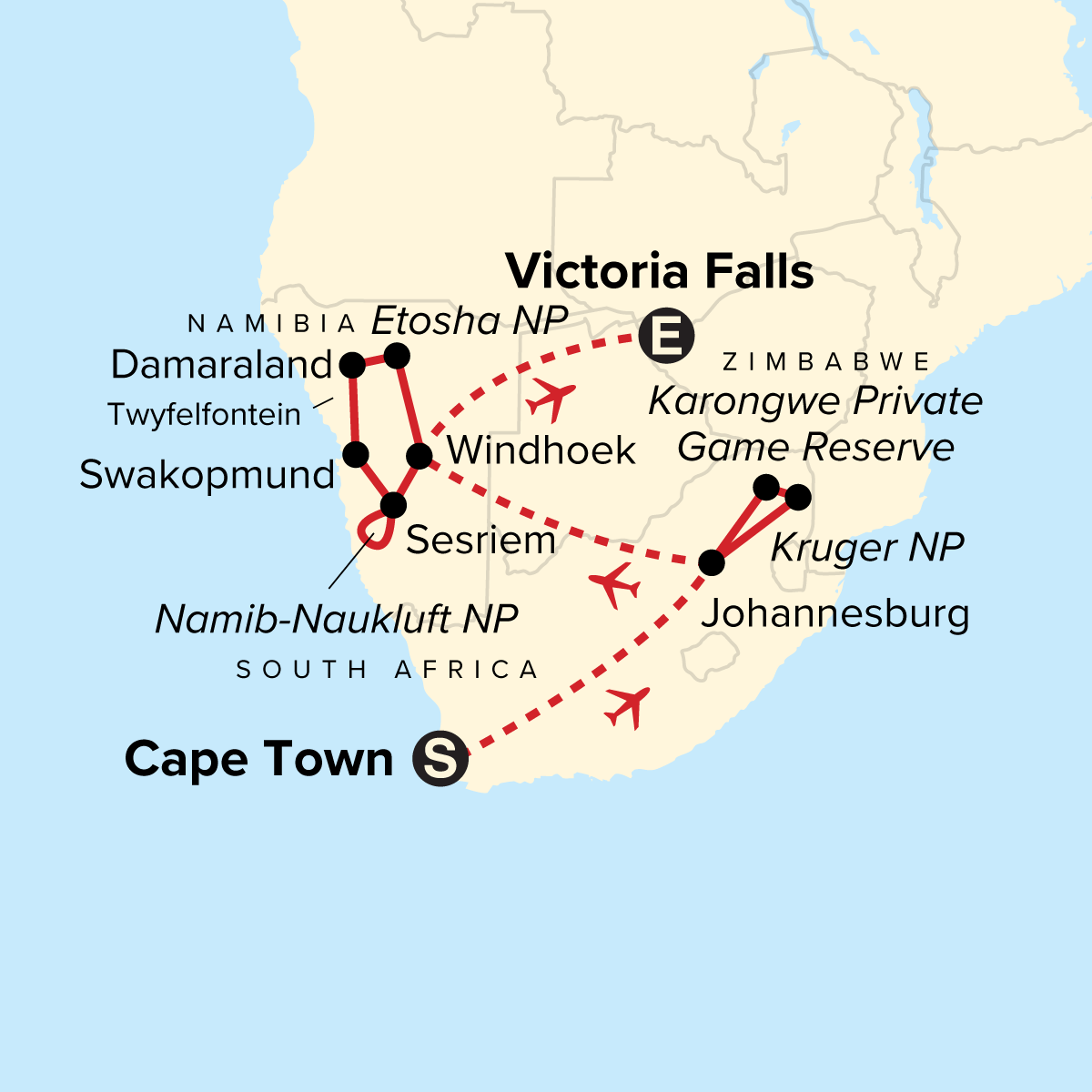
Journeys: Southern Africa Highlights

-
Length
21 Days
-
Quality
This indicates the overall quality of the tour operator's products. A low rating does not mean it is not good - it just means that it does not include as much, or perhaps is of a more standard quality than the higher quality tours. For example, a 3 star quality rating means that it is a more standard/economical tour, while 5 stars is a very luxurious tour that often includes a lot of amenities. -
Starts in
Cape Town (South Africa)
-
Ends in
Victoria Falls (Zambia & Zimbabwe)
-
Available Tour Start Dates
JUL 6, 2026 to DEC 31, 2028
-
Activity Level
Easy
-
Style
Fully-Guided
-
Guaranteed Date(s)
Yes means that there is at least one tour date that the vendor guarantees will occur. No means that there is not at least one tour date that the vendor guarantees will occur, which usually means that the vendor wants a certain amount of reservations on each tour in order for each one to occur. Of course, the terms and conditions of the vendor do allow for the vendor to cancel guaranteed tour dates for certain reasons (for example, a natural disaster).Yes
-
Special Interest(s)
National Geographic
Greater exploration, insider access, and the freedom to roam - all without sacrificing comfort., Small GroupGroup trips average 12 travellers per departure, depending on the adventure. The maximum is usually no more than 16, but some can be smaller or bigger, depending on the trip. Check individual trips for details.
From
Pricing listed is per person, based on double occupancy, and is the least expensive price for at least one departure date of this tour. Price is for the tour only. Additional items, including but not limited to, airfare (unless noted otherwise), travel insurance, and more, are additional.
$9,999.00
Contact Us for a Special Price!
Overview
From multicultural cities to awe-inspiring landscapes and iconic wildlife, discover southern Africa's most incredible attractions on one epic journey. Scan the grasslands of Kruger National Park for elephants and big cats, take in the otherworldly desert vistas of Namibia, and feel the thundering power of Victoria Falls, a UNESCO World Heritage site. Enjoy delicious traditional foods along the way, and get a taste of daily life on visits to local markets.
Visited During Tour
Cape Town (South Africa) | Damaraland (Namibia) | Etosha National Park (Namibia) | Johannesburg (South Africa) | Karongwe Private Game Reserve (South Africa) | Kruger National Park (South Africa) | Sesriem (Namibia) | Swakopmund (Namibia) | Victoria Falls (Zambia & Zimbabwe) | Windhoek (Namibia)
Dates, Offers & Prices
Tour Itinerary
Accommodations
More Details
Dates, Offers & Prices
The following are Journeys: Southern Africa Highlights tour dates available from G Adventures. Select a bonus offer graphic to view its details, including its terms.
There is at least one departure that the vendor is advising is Not Available for the selected year. Click here if you would like such tours to be included below.


Tour Itinerary
G Adventures Tour Code DSTNG-9437
-
Day
1Cape Town
Arrive at any time. Arrival transfer is included.
Exclusive Inclusions:
Transport
You will be met at the airport and transferred to the hotel to start your adventure.
Arrival Day and Welcome Meeting
Meet your Cape Town G Adventures representative at the hotel - please have a look at the information board in the hotel for the meeting time. Your rep will go through your tour details, help you with booking optional activities, and be your contact person for the next few days.
Accommodations: The Portswood Hotel -
Day
2Cape Town
Begin the day with an exploration of vibrant Cape Town, wandering through the multicultural Bo-Kaap neighborhood. Then enjoy an exclusive guided tour of Kirstenbosch National Botanical Garden, named by National Geographic Travel as one of the world's 10 most magnificent gardens. Later, stop by Boulders Beach to see the resident population of African penguins, and continue to the Cape Point lighthouse and the Cape of Good Hope, the southwesternmost point in Africa.
- Meals Included:
- Breakfast
Exclusive Inclusions:
Private Vehicle
Settle in and scan the scenery from the convenience of a private vehicle.
Kirstenbosch Guided Walk
Stop and smell the flowers on a tour specially designed for National Geographic travellers. Visit Kirstenbosch Botanical Garden, led by an expert who will talk about the history of the gardens, its exhibits and a behind the scenes look at the mother beds. The garden is administered by the South African National Biodiversity Institute (SANBI) who have received funding from National Geographic and the site has been named one of the Top 10 gardens in the world by National Geographic Traveler.
Guided Cape Town Orientation Tour and Excursion to Cape Point
Enjoy a guided orientation tour of vibrant Cape Town. Continue on to Cape Point to enjoy a stunning vista and visit the penguins at Boulders Beach.
Accommodations: The Portswood Hotel -
Day
3Cape Town
Enjoy a day of leisure in Cape Town, choosing from a variety of optional activities. Hop on a cable car to the summit, taking in extraordinary views of the city and the Atlantic seaboard. Or explore the Cape Winelands, visiting the historical city of Stellenbosch, touring wine estates with expert guides, and indulging in a variety of tastings and pairings.
There is something for everyone in Cape Town. Visit Table Mountain, walk the V&A Waterfront or embark on a wine tour in and around Stellenbosch. For the adventurous, opt to go, abseiling. Wander through the city centre, which has some of the oldest buildings and gardens in South Africa. Check out the Cultural Historical Museum, Planetarium, and many other museums and theatres.
If you are interested in visiting Robben Island - you must book it directly with the museum on their website prior to travel: http://www.robben-island.org.za Due to high demand, it is common that this tour can be sold out over one month in advance.
- Meals Included:
- Breakfast
Exclusive Inclusions:
Free Time
Enjoy a day of your leisure in this cosmopolitan and charming city.
Accommodations: The Portswood Hotel4Optional Activities for Day 3
Show -
Day
4Cape Town/Johannesburg
Fly to Johannesburg, then take a guided tour of Soweto township. Soweto was an important center of South Africa's anti-apartheid movement and home to its leader, Nelson Mandela. Visit the Mandela House Museum and learn about this painful chapter in the country's history. In the evening, enjoy a traditional South African dinner with your fellow travellers.
- Meals Included:
- Breakfast
- Dinner
Exclusive Inclusions:
Plane
Look! Up in the sky! It's a bird! It's a plane! It's... yup, it is a plane, actually.
Soweto Tour
Take a guided tour of bustling Soweto and learn more about its important history. The residential area was created under apartheid and played a significant role in bringing the issues of segregation to the forefront. The anti-apartheid movement was launched here by its most famous resident, Nelson Mandela.
Traditional South Africa Braai (Barbecue)
Enjoy a spread of grilled meats, vegetables, homemade salads, and the opportunity to taste some of the South African flavours after your welcome meeting.
Accommodations: Southern Sun Rosebank -
Day
5Johannesburg/Greater Kruger Area
Set out towards Kruger National Park via the magnificent Panorama Route, one of the world's most picturesque drives. Make stops at the dramatic Blyde River Canyon and Bourke's Luck Potholes, and take in panoramic views of the forest-covered valley from the God's Window viewpoint. Continue to our lodge near Kruger National park, savour a delicious South African Dinner in this picturesque location.
Today is a very long driving day; however, we will make many stops along the way at sites along the Panorama Route.
- Meals Included:
- Breakfast
- Dinner
Exclusive Inclusions:
Private Vehicle
Settle in and scan the scenery from the convenience of a private vehicle.
Panorama Route Scenic Drive
Enjoy a scenic drive along the famed Panorama Route. You'll see magnificent mountains, panoramic passes, valleys, and waterfalls. There will also be stops at Blyde River Canyon, Bourke's Luck Potholes, and God's Window.
Accommodations: Umbhaba Eco Lodge -
Day
6Kruger National Park
Rise early and climb aboard an open jeep for a full-day safari in Kruger National Park-home to an extraordinary array of large mammals. Spot elephants, lions, giraffes, and perhaps elusive leopards as we explore this breathtaking wilderness of savanna and scrubland. Return to our lodge in the evening, where you can take some time to relax and enjoy the nocturnal sounds of the bush.
At over 19,000 sq km (7,500 sq mi), South Africa's Kruger National Park is one of the largest and most impressive animal reserves in the world. With 147 species, Kruger has more species of large mammals than any other park on the continent.
- Meals Included:
- Breakfast
- Dinner
Exclusive Inclusions:
Kruger National Park Open Vehicle Wildlife Safari Drive - Full day
Hop in a 4x4 safari vehicle and get yourself one step closer to the surrounding nature. Be ready to spot elephants, giraffes, hippos, lions, zebras, and many other species in this impressive South African national park.
Accommodations: Umbhaba Eco Lodge -
Day
7Greater Kruger Area/Karongwe Private Game Reserve
Travel to the Karongwe Private Game Reserve, a pristine wildlife sanctuary located in the Greater Kruger area. Meet with a researcher from the Endangered Wildlife Trust's Cheetah Metapopulation Project-a program funded in part by National Geographic's Big Cats Initiative-and learn about efforts to protect the region's cheetahs and other carnivores. The researcher then joins us for a wildlife-viewing excursion through the reserve.
For the next two days, enjoy ranger-led morning and evening wildlife safari drives in an open safari vehicle in Karongwe Nature Reserve, searching for Africa's famed Big Five. With over 9,000 hectares (22,240 acres) of supreme African bushveld, Karongwe Private Game Reserve is home to many creatures, and our safari drives provide several opportunities for wildlife viewing. We use various accommodations within the reserve (the location is based on availability). During your time here, you will either stay in lodge rooms or very comfortable permanent tents (both of equal quality and with similar amenities).
Wildlife safari drives are conducted with qualified wildlife rangers and local expert trackers who will share their vast experience of the African bush.On some occasions, if space is unavailable, we may need to change accommodations or even use a different private reserve. In such a case, be assured we will choose other lodges or comfort camps (of equal quality) within the Greater Kruger area.
- Meals Included:
- Breakfast
- Lunch
- Dinner
Exclusive Inclusions:
Private Vehicle
Settle in and scan the scenery from the convenience of a private vehicle.
Carnivore Conservation Experience
Meet with a researcher from the Endangered Wildlife Trust's Cheetah Metapopulation Project, a project managed by National Geographic grantee Vincent van der Merwe. A member of Vincent's team will give a talk about cheetahs in South Africa and the important research CMP is doing. We will also discuss conservation within parks and reserves in South Africa and National Geographic's Big Cats Initiative. You will then be accompanied by the researcher on a wildlife safari drive to give you more insight into cheetahs and other carnivores.
Accommodations: Karongwe Private Game Reserve - Lodges -
Day
8Karongwe Private Game Reserve
Spend the day exploring Karongwe on morning and afternoon safaris with our local guides. Search for Africa's famed "big five" as we drive through the shrublands of the bushveld. Back at camp, relax on deck or take a walk around the grounds.
Wake up before the sun (around 5am) and sip your morning coffee before heading out on a morning wildlife safari drive. Return to the lodge for brunch and some leisure time. Converse on the deck, walk the grounds and gardens, and enjoy high tea. Following tea, it's time for a late afternoon safari drive. After spotting tons of wildlife, it's time to return to camp and freshen up before dinner, a traditional braai.
- Meals Included:
- Breakfast
- Lunch
- Dinner
Exclusive Inclusions:
Karongwe Private Reserve Open Vehicle Wildlife Safari Drive
Jump into a safari 4x4 and keep your eyes open for fantastic wildlife encounters. Wildlife safari drives are conducted with qualified wildlife rangers and local expert trackers; both will share their vast experience of the African bush.
Free Time
Relax and enjoy some down time between wildlife safari drives.
Boma Braai
At Karongwe, the Boma dinner will indulge your taste buds with South African cuisine, while you enjoy the African wilderness. Take part in a culinary journey that reflects South Africa's rich cultural and culinary heritage, all from an enclosed outdoor area, lit by lanterns and a warming fire. You'll taste your way through traditional dishes including braaied meats (Barbeque), potjiekos (traditional pot stew), and a malva pudding (traditional dessert); all made from local ingredients. Both your stomach and your heart will be full from this cultural immersion, nature connection, social interaction, and delicious meal.
Accommodations: Karongwe Private Game Reserve - Lodges -
Day
9Karongwe Private Game Reserve/Johannesburg
Embark on one last safari this morning, keeping a lookout for Karongwe's iconic inhabitants. Then head back to the city, where you'll enjoy dinner in our lodge.
- Meals Included:
- Breakfast
- Dinner
Exclusive Inclusions:
Karongwe Private Reserve Open Vehicle Wildlife Safari Drive
Jump into a safari 4x4 and keep your eyes open for fantastic wildlife encounters. Wildlife safari drives are conducted with qualified wildlife rangers and local expert trackers; both will share their vast experience of the African bush.
Private Vehicle
Settle in and scan the scenery from the convenience of a private vehicle.
Accommodations: Southern Sun Rosebank -
Day
10Johannesburg/Windhoek
Fly to Windhoek and transfer to your hotel. Enjoy free time to explore the Namibian capital this afternoon.
- Meals Included:
- Breakfast
Exclusive Inclusions:
Plane
Look! Up in the sky! It's a bird! It's a plane! It's... yup, it is a plane, actually.
Accommodations: Windhoek Country Club Resort -
Day
11Windhoek/Sesriem
Set off from the Namibian capital towards Sesriem, the gateway to jaw-dropping Namib-Naukluft National Park. Drive past red-hued desertscapes, stark camel thorn trees, and dramatic curved dunes while keeping an eye out for the astonishing creatures that call these arid lands home-the oryx, springbok, jackal, hyena, and more. Settle in to our lodge and relax poolside, watching a fiery crimson sunset over the desert.
Enjoy postcard perfect desert scenery around Sesriem and Sossusvlei - vast desertscapes of reds and orange, stark camel thorn trees and towering dunes with dramatic curved ridges. Also keep an eye out for the surprising amount of wildlife that call this area home such as oryx, springbok, jackal, ground squirrel and hyena.
- Meals Included:
- Breakfast
- Dinner
Exclusive Inclusions:
Private Vehicle
Settle in and scan the scenery from the convenience of a private vehicle.
Accommodations: Sossusvlei Lodge -
Day
12Sesriem
Embark on a thrilling excursion into one of Africa's largest national parks. Explore the Namib desert, the oldest desert in the world; and venture to the massive dunes at Sossusvlei and the white clay pan of Deadvlei. Capture dramatic images of dead camel thorn trees against a backdrop of orange dunes and a crisp blue sky. Then visit the Sesriem Canyon, a natural gorge carved out by the Tsauchab River over millions of years.
- Meals Included:
- Breakfast
- Dinner
Exclusive Inclusions:
Private Vehicle
Settle in and scan the scenery from the convenience of a private vehicle.
4x4
Roads? Where this rough-and-ready vehicle's going, we don't need roads.
Sossusvlei Dunes Visit
This area is famous for its high, red sand dunes. This clay and salt pan is surrounded by the dunes, making it a spectacularly beautiful sight with a remote and isolated feel.
Sesriem Canyon Visit
Enjoy a short stop at Sesriem Canyon, a small canyon typical of the area. The Tsauchab River flows through the canyon every five to ten years, and this creates the nearby salt and clay pan of Sossusvlei.
Accommodations: Sossusvlei Lodge -
Day
13Sesriem/Swakopmund
Continue by road through changing desert landscapes towards the coastal city of Swakopmund. Look out for roaming zebra, kudu, springbok, and oryx on the way, and take a break in the quirky town of Solitaire before heading into the countryside. Here, we meet a local for a 4x4 drive through the desert, learning about the survival strategies of bushmen who lived in this inhospitable area thousands of years ago. We also search for the smaller wildlife that has managed to survive here, such as snakes, geckos, spiders, and an array of insects.
- Meals Included:
- Breakfast
- Lunch
Exclusive Inclusions:
Private Vehicle
Settle in and scan the scenery from the convenience of a private vehicle.
Living Desert Tour
Hop into a 4x4 vehicle and set out into the desert. An expert guide will point out signs of animal life and emphasize survival in the harsh desert landscape for both humans and animals.
Accommodations: Hansa Hotel -
Day
14Swakopmund
Enjoy a free morning in Swakopmund, getting a taste of the town's unique Afro-German culture; or opt for sandboarding in the Namib desert. This afternoon, take a tour of Mondesa township with a local guide, learning about its people and history. Visit the local market for an introduction to traditional foods such as wild spinach, mopane worms, and dried sardines or kapenta. Stop by an arts and crafts shop; chat with the locals; and round off the day with dinner and a performance at a cozy family-run establishment.
Explore the town's unique mix of German and African culture and opt to visit curio shops, the museum and restaurants. Optional activities include sandboarding.
- Meals Included:
- Breakfast
- Dinner
Exclusive Inclusions:
Free Time
Enjoy a free morning in the historic coastal town of Swakopmund.
Mondesa Township Walk
Visit the community of Mondesa Township with an expert resident guide. Learn about its daily life, history and traditions through an immersive experience with the welcoming people that live here. Visit its lively market for an introduction to traditional foods like wild spinach, mopane worms, and dried kapenta fish. Also visit an arts-and-crafts shop that helps train the township's youth in traditional crafts. Drop by a shebeen (tavern) to enjoy a favourite drink, and meet some local residents. Finally, continue on to a nearby family run establishment for dinner and local entertainment.
Accommodations: Hansa Hotel3Optional Activities for Day 14
Show -
Day
15Swakopmund/Damaraland
Make your way to Twyfelfontein-Namibia's first UNESCO World Heritage site-to see some of Africa's largest concentrations of petroglyphs. Marvel at these remarkable engravings, carved by prehistoric hunter-gatherers and depicting rhinos, elephants, and ostriches, as well as human and animal footprints. Then continue to our lodge on the heart of the Damaraland area. Enjoy some free time to swim in the pool or admire a colourful sunset from the deck.
- Meals Included:
- Breakfast
- Dinner
Exclusive Inclusions:
Private Vehicle
Settle in and scan the scenery from the convenience of a private vehicle.
Prehistoric Rock Engravings Guided Tour
Step back in time to see prehistoric rock engravings made during the early Stone Age. Their exact origin is uncertain, but these works depicting animals and hunters are probably the work of Bushmen or Nama artists estimated to have lived near Twyfelfontein at least 5,000 years ago. Marvel at the more than 2,500 rock carvings and paintings and understand why this is Namibia's first UNESCO World Heritage Site.
Private Vehicle
Settle in and scan the scenery from the convenience of a private vehicle.
Accommodations: Hansa Hotel -
Day
16Damaraland/Etosha National Park Area
Enjoy a relaxed morning at our lodge and explore the rich sandstone treasure of Damaraland. In the afternoon, travel towards Etosha National Park, arguably Namibia's most spectacular wildlife sanctuary. Settle into our lodge, located outside of the park.
- Meals Included:
- Breakfast
- Dinner
Exclusive Inclusions:
Free Time
Enjoy a free morning at the lodge, and opt for a self-guided walk in the property.
Private Vehicle
Settle in and scan the scenery from the convenience of a private vehicle.
Accommodations: Taleni Etosha Village -
Day
17Etosha National Park Area
Spend a full day on safari in Etosha National Park, where open grasslands converge on a massive salt pan. Etosha harbours some of the largest populations of lions, elephants, and other endangered species, so keep your camera on the ready as you explore in your open vehicle. Enjoy lunch at one of the park's rest areas, where you can also take a swim; and sit back and watch all manner of creatures-including hundreds of species of birds-flock to the nearby watering hole.
After the vast desert, Etosha National Park, offers a contrast of wide open grasslands, a massive salt pan that covers 4731km? and tall camel thorn trees intermixed with Mopani trees. With a combination of natural waterholes, and diverse vegetation, wildlife flock to the park. Some of the largest elephants in Africa can be found in areas of thicker vegetation, as well as leopards. Lions, giraffe, ostrich and many antelope species can be found in the grasslands, while birders will love the salt pans which attract flamingos in the rainy season. More than 340 bird species have been counted in Etosha National Park including the European bee-eater, the kori bustard and numerous migratory birds.
- Meals Included:
- Breakfast
- Dinner
Exclusive Inclusions:
Etosha Open Vehicle Wildlife Safari Drive
Set off in an open 4x4 safari vehicle with a naturalist guide in search of the stunning wildlife in the park. Wildlife often come to the many watering holes to drink, so keep your eyes peeled for many animals on the move.
Accommodations: Supplier Driver - Taleni Etosha Village -
Day
18Etosha National Park Area/Windhoek
After breakfast, visit the Cheetah Conservation Fund, a global research and education center founded by National Geographic Grantee Dr Laurie Marker. Tour the facility to learn about the important conservation and community outreach work they do to protect the world's fastest land animal, and enjoy a talk by one of the researchers. Then head out on a drive through the grounds to meet some of the center's rescued and rehabilitated cheetahs. Continue to Windhoek for our final evening.
- Meals Included:
- Breakfast
- Lunch
Exclusive Inclusions:
Private Vehicle
Settle in and scan the scenery from the convenience of a private vehicle.
Cheetah Conservation Experience
The Cheetah Conservation Fund is a global field research and education facility founded by Dr. Laurie Marker whose research has been supported by National Geographic. Tour the centre and learn about the important conservation and community outreach work they perform as one of the world's leading organizations dedicated to saving the cheetah in the wild. One of the program's researchers will give us a lecture before we head out on a cheetah drive to view some of these incredible creatures up close in their natural habitat. Conclude the experience by sitting down as a group for lunch on the veranda that overlooks the magnificent Waterberg Plateau.
Accommodations: Windhoek Country Club Resort -
Day
19Windhoek/Victoria Falls
Catch a flight to the town of Victoria Falls in Zimbabwe, named after one of the most powerful waterfalls on Earth. Visit a nearby village and go grocery shopping in the bustling market. Then sit down with a local family for dinner, helping your hosts prepare a traditional Zimbabwean meal using the ingredients you picked out, and hear stories about local life and culture.
The mist off Victoria Falls can rise to a height of more than 400m (1312 ft). Local tribes used to call the falls Mosi-o-Tunya or "the smoke that thunders." Explorer and missionary David Livingstone renamed the falls after Queen Victoria when he first saw them in 1855.
- Meals Included:
- Breakfast
- Dinner
Exclusive Inclusions:
Plane
Look! Up in the sky! It's a bird! It's a plane! It's... yup, it is a plane, actually.
Zimbabwean Family Dinner
Flatter Ncube is the head of her family which includes two sisters and numerous children. She's the youngest of a family of 10 and, now in her early 40s, lives in the village she was raised in near Victoria Falls. There she takes care of her extended family on their homestead, which she and they have been proudly building by hand, brick by brick, for years. Flatter's story highlights that life isn't easy in Africa, but despite its challenges, there is much love and laughter and a strong sense of family here. Visit Flatter's homestead in her rural village; meet her and some of her family, and walk with some of them throughout the property, among the fruit and vegetable plants the family grows for consumption. (They even plant hot chillies among the vegetables to discourage nosy elephants.) Then help the family prepare a traditional Zimbabwean dinner, which we'll all eat together outside on the property, weather permitting. Ingredients for the meal will have been hand-selected earlier in the day, at the bustling and friendly local village market. This experience offers great insight into typical African life, and ultimately reinforce how we all really want and need the same things in life: a stable home full of love, a good education, and plenty of opportunity for our children.
Accommodations: Explorers Village Lodge - Deluxe -
Day
20Victoria Falls
Set out for a tour of magnificent Victoria Falls. Scottish explorer David Livingstone named them after Britain's Queen Victoria, while their older, indigenous name is Mosi-oa-Tunya-"the smoke that thunders." Opt for a scenic sunset cruise on the Zambezi River; or take a day trip to wildlife-rich Chobe National Park.
If you have an activity planned for this morning, we will reschedule your Falls tour for this afternoon, or tomorrow morning.
- Meals Included:
- Breakfast
Exclusive Inclusions:
Victoria Falls Guided Tour
Join a knowledgeable guide for an unforgettable experience at Victoria Falls. Explore the rainforest and learn about the geology, history, and local legends of this world wonder. After your immersion, get up close to the falls and discover the beauty of "the smoke that thunders." Be sure to have your camera ready!
Accommodations: Explorers Village Lodge - Deluxe3Optional Activities for Day 20
Show -
Day
21Victoria Falls
Depart at any time.
- Meals Included:
- Breakfast
Exclusive Inclusions:
Departure Day
Not ready to leave? Your CEO can help with any onward travel arrangements you require.
Accommodations
Select a destination below to to view the hotel(s) included by G Adventures in their Journeys: Southern Africa Highlights tour:
Cape Town
The Portswood Hotel
Location
Portwood Road
Portwood Square, V&A Waterfront
Cape Town, South Africa-8001
Other Details
- Hotel as shown or similar (G Adventures may replace it with a similar property)
Etosha National Park
Etosha Village
Location
Etosha National Park, Namibia
Other Details
- Hotel as shown or similar (G Adventures may replace it with a similar property)
Etosha Village Supplier Driver Standard Room DBB
Location
Etosha National Park, Namibia
Other Details
- Hotel as shown or similar (G Adventures may replace it with a similar property)
Johannesburg
Southern Sun Rosebank
Location
Cnr Tyrwhitt & Sturdee Ave
Johannesburg, South Africa-2196
Other Details
- Hotel as shown or similar (G Adventures may replace it with a similar property)
Kruger National Park
Umbhaba Eco Lodge
Location
R40
Hazyview, Mpumalanga
Kruger National Park, South Africa
Other Details
- Hotel as shown or similar (G Adventures may replace it with a similar property)
Karongwe Portfolio - Chisomo Safari Camp
Location
R36
Kruger National Park, South Africa
Other Details
- Hotel as shown or similar (G Adventures may replace it with a similar property)
Sesriem
Sossusvlei Lodge
Location
D826, Sesriem
Sesriem, Namibia
Other Details
- Hotel as shown or similar (G Adventures may replace it with a similar property)
Swakopmund
Hansa Hotel
Location
3 Hendrik Witbooi Street
Swakopmund, Namibia
Other Details
- Hotel as shown or similar (G Adventures may replace it with a similar property)
Victoria Falls
Explorers Village Lodge
Location
Adam Stander Dr
Victoria Falls, Zimbabwe
Other Details
- Outdoor Pool, Parking
- Hotel as shown or similar (G Adventures may replace it with a similar property)
Windhoek
Windhoek Country Club Resort
Location
B1 Western Bypass, Windhoek South
Windhoek, Namibia
Other Details
- Outdoor Pool, Restaurant, 24-hour Front Desk, Wifi, Parking
- Hotel as shown or similar (G Adventures may replace it with a similar property)
More Details
G Adventures is informing us of the following additional details regarding their Journeys: Southern Africa Highlights tour:
Group Size
Max 16, avg 12.
What's Included
Your Journeys Highlight Moment: Kirstenbosch Guided Walk, Cape TownYour Journeys Highlight Moment: Carnivore Conservation Experience, Karongwe Private Game ReserveYour Journeys Highlight Moment: Mondesa Township Walk, SwakopmundYour Journeys Highlight Moment: Cheetah Conservation Experience, OtjiwarongoYour Journeys Highlight Moment: Zimbabwean Family Dinner, Victoria FallsYour Foodie Moment: Traditional South Africa Braai (Barbecue), JohannesburgYour Foodie Moment: Boma Braai, Karongwe Private Game Reserve. Arrival transfer. Orientation drive of Cape Town. Excursion to Cape Point and Boulders Beach. Soweto tour. Panorama Route scenic drive with entrances. Kruger National Park and private nature reserve wildlife safari drives in open vehicles. Sossusvlei desert excursion. Desert excursion with a local. View the Twyfelfontein ancient petroglyphs. Full-day open-vehicle wildlife safari drive in Etosha. Tour of Victoria Falls. Internal flights. All transport between destinations and to/from included activities.
Message from G Adventures About Travel Insurance
Travel insurance is compulsory in order to participate on any of our trips. When travelling on a group trip, you will not be permitted to join the group until evidence of travel insurance has been sighted by your leader, who will take note of your insurance details. When selecting a travel insurance policy we require that at a minimum you are covered for medical expenses including emergency evacuation and repatriation. A minimum coverage of USD200,000 is required. We strongly recommend that the policy also covers personal liability, cancellation, curtailment and loss of luggage and personal effects. Some tours include adventure activities that require extra coverage (e.g. crampon use); please review your itinerary and make sure that you are covered for all included activities. If you have credit card insurance we require proof of purchase of the trip (a receipt of credit card statement) with a credit card in your name. Contact your bank for details of their participating insurer, the level of coverage and emergency contact telephone number.
Optional Activities
G Adventures is offering the following optional activities at an additional cost, subject to availability:
Cape Town- Cape Winelands Tour (1295ZAR per person)- Two Oceans Aquarium (235ZAR per person)Table Mountain- Table Mountain Cable Car (420ZAR per person)Dyer Island- Whale and Bird Watching at Dyer Island (1450ZAR per person)Swakopmund- Fat Tire Bike Tours (450NAD per person)- Sandboarding in the Namib Desert (700NAD per person)- Sea Kayaking (800NAD per person)Victoria Falls- River Song Sunset Cruise (79USD per person)- Canoeing the Zambezi (160USD per person)- Full Day Excursion to Chobe National Park- Victoria Falls Historic Bridge Tour (55USD per person)
What transportation will we take on this trip?
In Namibia, the vehicle used will depend on the number of passengers. This style of transportation is a comfortable way to travel through the region, allowing the group to travel through the cities and parks with ease, with more opportunities to stop and either wander around or view the sites. In South Africa the vehicle used will depend on the number of passengers as follows: 10-16 guests: 17 Seater Mercedes Sprinter Coach (A/C)6-9 guests: 14 Seater Toyota Quantum (A/C)3-5 guests: Mercedes Benz Vito OR Similar (A/C)1-2 guests: Nissan Livina X-G or Toyota Avanaza (A/C) For the wildlife safari drives on in the Kruger area we use an open safari vehicle.For group sizes of 10 to 16, you will have a dedicated driver and Expedition Leader.
Accommodation Summary
Hotel (9 nts), Lodge (9 nts), Comfortable tent or chalets (2 nts).
Meals Included
20 breakfasts, 4 lunches, 13 dinners
What are the meals like on this trip?
Eating is a big part of travel. Travelling with G Adventures you experience the vast array of wonderful food that is available in Southern Africa.
Group Leader
CEO (Chief Experience Officer) for Kruger & Namibia, local CEO in Cape Town and Victoria Falls, local guides/rangers.
What is the group leader like?
On this tour, you will be accompanied by one group National Geographic Expedition Leader for the Kruger and Namibia portion, and a local Expedition Leader in Victoria Falls and Cape Town. The Expedition Leader will be the group manager and leader. All of our leaders in southern Africa are registered and licensed tourism guides, meaning they’ve studied to have a broad knowledge base of the region’s history, cultures, and wildlife, and are legally certified to lead/guide tours in the regions visited. Most of our leaders in the region are from South Africa, though it may be possible that you’ll have a leader from another country in the southern African region.All safari guides are certified safari guides, and are of course very skilled and experienced drivers. With years of experience taking wildlife seekers into the wildlife parks, our local safari guides are exactly what will make your safari a success.We also use local guides where we think more specific knowledge will add to the enjoyment of the places we are visiting.Safari guides: All safari guides are certified safari guides, and are of course very skilled and experienced drivers. With years of experience taking wildlife seekers into National Parks and Reserves, our local safari guides are exactly what will make your safari a success.
International Flights
Check-in times and baggage allowances/restrictions vary by airline and can change at any time. For the most up-to-date information for your flight, please contact your airline. We recommend checking in online in advance to avoid potential delays at the airport.
Transportation
Air-conditioned touring vehicle, 4x4, open safari vehicle, plane, walking.
Minimum Age
You must be 18 to travel unaccompanied on a G Adventures tour. For minors travelling with a guardian over 21 years old, the minimum age is 12.
Checklist
Cold Weather:o Long-sleeved shirts or sweatero Scarfo Warm gloveso Warm hato Warm layerso Warm waterproof jacketDocuments:o Flight info (required) (Printouts of e-tickets may be required at the border)o Insurance info (required) (With photocopies)o Passport (required) (With photocopies)o Vouchers and pre-departure information (required)o Visas or vaccination certificates (With photocopies)Essentials:o Toiletries (required) (Shampoo, bodywash, soap, etc.)o Binoculars (optional)o Camera (With extra memory cards and batteries)o Cash, credit and debit cardso Day pack (Used for daily excursions or short overnights)o Ear plugso First-aid kit (should contain lip balm with sunscreen, sunscreen, whistle, Aspirin, Ibuprofen, bandaids/plasters, tape, anti-histamines, antibacterial gel/wipes, antiseptic cream, Imodium or similar tablets for mild cases of diarrhea, rehydration powder, water purification tablets or drops, insect repellent, sewing kit, extra prescription drugs you may be taking)o Flashlight/torch (Headlamps are ideal)o Fleece top/sweatero Footwearo Hato Locks for bagso Long pants/jeanso Moneybelto Outlet adaptero Personal entertainment (Reading and writing materials, cards, music player, etc.)o Reusable water bottleo Shirts/t-shirtso Sleepwearo Small travel towelo Sunglasseso Swimwearo Watch and alarm clocko Waterproof backpack covero Windproof rain jacketHealth & Safety:o Hand sanitizer (required)o Face masks (Clients will be only be required to wear a face mask where it is mandated by local regulations.)o Pen (Please bring your own pen for filling out documents.)o Quick Covid Test/Antigen Test (optional)Smart Dress:o Smart outfit (For evenings out)Warm Weather:o Sandals/flip-flopso Shorts/skirts (Longer shorts/skirts are recommended)o Sturdy water shoes/sandalso Sun hat/bandanao SwimwearNote: Seasons in Southern Africa are quite extreme. Winters (May to October) can be really cold and summers will be really hot. It is important to pack clothes for warm days and cool evenings, as well as a warm jacket for early morning wildlife safari drives.
Packing Note
Seasons in Southern Africa are quite extreme. Winters (May to October) can be really cold and summers will be really hot. It is important to pack clothes for warm days and cool evenings, as well as a warm jacket for early morning wildlife safari drives.
Are there any additional packing suggestions I should consider?
You will be on the move a lot, so our advice is to pack as lightly as possible. Your baggage should be clearly labelled and restricted to one soft compact suitcase, sports bag, or backpack. A daypack is also essential for carrying everyday items. Space is limited on transportation, so there is a limit of one main piece of luggage per person. Porters may not always be available, so be prepared to carry your own bags. It is important to pack clothes for warm days and cool evenings, as well as a warm jacket for early morning wildlife safari drives. A set of smart casual clothes is also advisable.The Southern Hemisphere essentially has the opposite weather to the Northern Hemisphere. The winter months of June, July and August, whilst clear and warm during the day (up to 25 degrees), can drop down to single figures and even below freezing at night. Between September and May it is considerably warmer with the time between October and March being the hottest, getting up to the high 30C and sometimes above. However it is always a dry heat and the temperature does drop at night. The wet season is between November and February, but this is not a bad time to go, as it generally does not rain for very long. We strongly recommend lots of layers to wear from the start of the day until the night. You might still need to wear a fleece jacket in the mornings, a t-shirt during the day and again the fleece jacket at sunset time. A woolen hat is also very much recommendable for the cold winter’s early morning wildlife safari drives.Please be advised that if you plan to bring a drone with you, the use of drones in national parks in Southern Africa is prohibited.
When can I do my laundry on this trip?
Laundry can be done at some lodges (at own expense).
Service Level
Upgraded: Quality accommodations and more inclusions than on other G Adventures tours, like meals, private transport, and activities.
Pricing and availability are subject to change and must be confirmed by one of our travel advisors, who can contact the vendor to do so. Intra-vacation air (also referred to as internal air) is usually based on economy class seating (do not assume otherwise, unless explicity noted otherwise) and may be 100% non-refundable at time of final payment. Air quotes (including intra-vacation airfare) may be subject to change until final payment has been received by the vendor. Flight confirmation may be based on availability. Air reservations may not be able to be confirmed until a passport copy is received by the vendor. The following charges are not included in the vacation price unless otherwise noted: airfare to and from the start of your vacation; airline baggage fees including checked and/or excess baggage fees; Federal inspection fees for the Federal U.S. Customs and Immigrations; International Air Transportation tax; agricultural tax; other per person taxes imposed by government entities; airport taxes and fees, including the September 11th Security fee, passenger facility charges, Federal domestic flight segment fees, and U.S. and international arrival and departure and other government-imposed fees added by the airline and applicable at time of booking; port taxes; passports; visas and vaccinations; tips to your Cruise Director, Local Host, driver, Local Guides, and/or ship's crew; gratuities on ferries, trains, and cruise ships; laundry; telephone; minibar; alcohol, beverages, and food outside of the contracted menu as presented at a hotel or restaurant or onboard your vessel (these extra items will be billed to you before leaving the hotel, ship, or restaurant); airport transfers on non-qualifying flights; optional excursions; additional activities and excursions purchased online; porterage at airports and train stations; Travel Protection; and all other items of a personal nature. Itinerary details are provided by the vendor. Vendors may reserve the right to change itineraries, even on existing reservations. There may be instances where the name of a tour contains a tour length in it, but where there is a version of the tour that is a different number of days in length. You can check the true length of a tour by referring to the length value listed in association with that tour. Destination images displayed on this web page, some which are supplied by the related vendor and some which are not, are intended to simply give a general representation of the region of the world being visited during the tour. Such images are not necessarily of the exact areas being visited during the tour. Hotel details (including, but not limited to: rating/class, descriptions, images, amenities and addresses) are provided by G Adventures. Hotel amenities may be communicated in shorthand by G Adventures (for example, if "Laundry" is listed that may only mean that the hotel has an optional fee-based service that would allow for your laundry to be done by their staff). We reserve the right to correct errors.