



1-855-602-7447
Experts available 7 days a week!



Hotels & Resort Deals
Select a destination...
 View All Hotels & Resort Deals
Vacation Interests
Miscellaneous
Tours By Type
Tour Deals
Select a destination...
 View All Tour Deals
Cruises From
Vacation Interests
Career Discounts
Featured Destinations
Select a destination for info and deals...
Destination Ports
Cruises sailing in each region...
- Transfer Your Booking To Us
- Book Shore Excursions
- Book Land Tours
- Save on Passport & Visa Services
-
![Arrow]() View All Customer Service Resources
View All Customer Service Resources
Saving Tools
- Access Reservation (web-made bookings only)
- Make a Payment
- Add Travel Insurance
- Pre-Cruise Registration
For Existing Reservations
- Land Vacation FAQs
- Cruise FAQs
- Cruise Port Directions
- Contact Us
Useful Links


Kilimanjaro - Marangu Route & Serengeti Adventure

-
Length
12 Days
-
Quality
This indicates the overall quality of the tour operator's products. A low rating does not mean it is not good - it just means that it does not include as much, or perhaps is of a more standard quality than the higher quality tours. For example, a 3 star quality rating means that it is a more standard/economical tour, while 5 stars is a very luxurious tour that often includes a lot of amenities. -
Starts in
Moshi (Tanzania)
-
Ends in
Arusha (Tanzania)
-
Available Tour Start Dates
SEP 6, 2026 to DEC 30, 2027
-
Activity Level
Challenging
-
Style
Fully-Guided
-
Guaranteed Date(s)
Yes means that there is at least one tour date that the vendor guarantees will occur. No means that there is not at least one tour date that the vendor guarantees will occur, which usually means that the vendor wants a certain amount of reservations on each tour in order for each one to occur. Of course, the terms and conditions of the vendor do allow for the vendor to cancel guaranteed tour dates for certain reasons (for example, a natural disaster).Yes
-
Special Interest(s)
Small Group
Group trips average 12 travellers per departure, depending on the adventure. The maximum is usually no more than 16, but some can be smaller or bigger, depending on the trip. Check individual trips for details.
Not Available
Overview
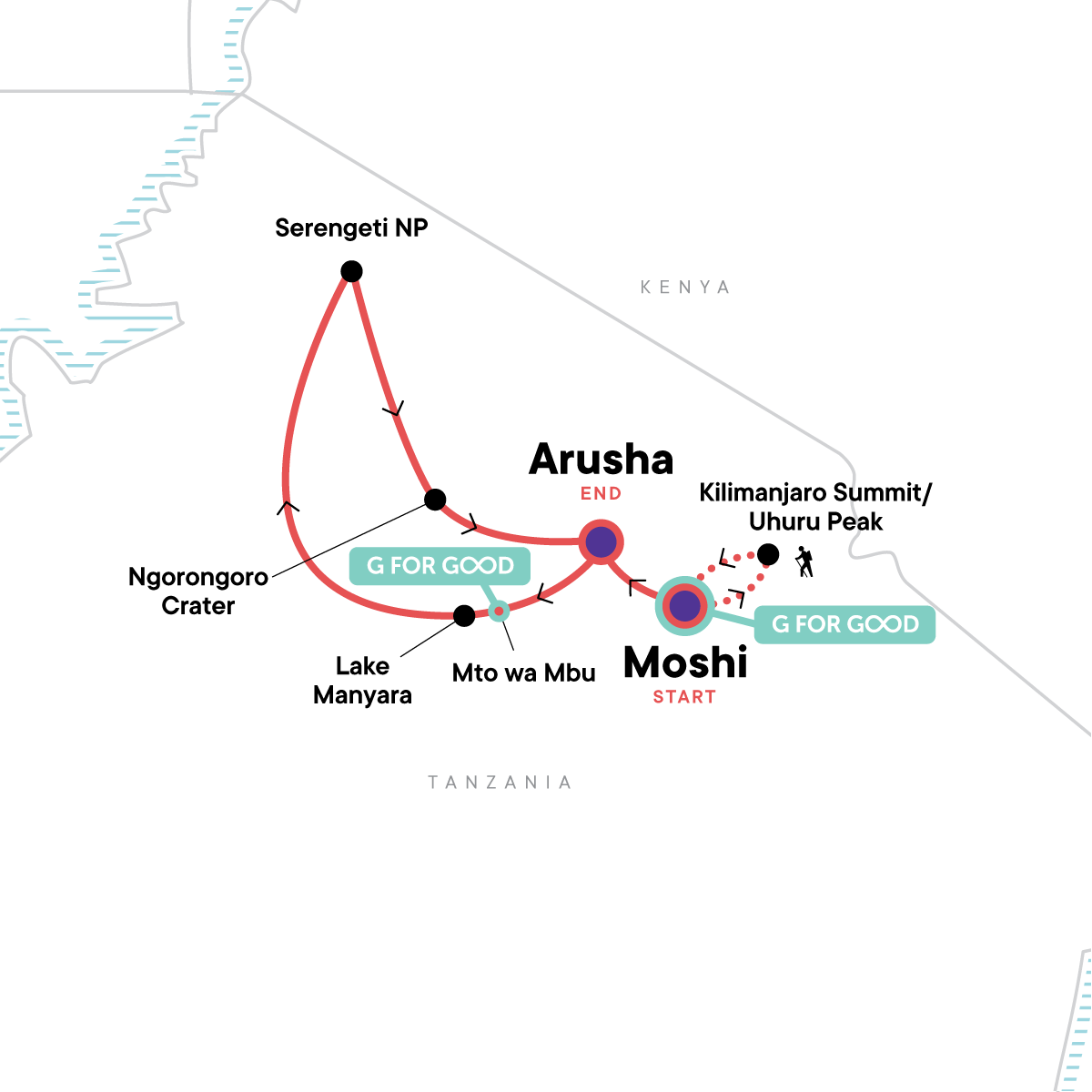
For many travellers, Africa is a once-in-a-lifetime experience. If you're only going to go once, take this incredible 12-day adventure that wraps mighty Kilimanjaro, the sweeping Serengeti, and the stupendous Ngorongoro Crater together in one unbeatable package. Kick things off with a four-day ascent to the very roof of Africa, then return to Moshi to meet with residents of an isolated Maasai village and members of a local G Adventures for Good project before heading out into the wild lands in search of the "big five" and camping under the stars. This is quintessential Africa.
Visited During Tour
Arusha (Tanzania) | Horombo Huts (Tanzania) | Kibo Huts (Tanzania) | Mandara Huts (Tanzania) | Moshi (Tanzania) | Mto Wa Mbu (Tanzania) | Ngorongoro Conservation Area (Tanzania) | Serengeti National Park (Tanzania)
Dates, Offers & Prices
Tour Itinerary
Accommodations
More Details
Dates, Offers & Prices
The following are Kilimanjaro - Marangu Route & Serengeti Adventure tour dates available from G Adventures. Select a bonus offer graphic to view its details, including its terms.
There is at least one departure that the vendor is advising is Not Available for the selected year. Click here if you would like such tours to be included below.
Tour Itinerary
G Adventures Tour Code DTMS-7201
-
Day
1Moshi
Arrive at any time.
Arrive in Moshi and head to the hotel. Attend a pre-departure meeting with the local guide to go over last minute details of the trip.
Please note: While it is our intention to adhere to the route described, there is a certain amount of flexibility built into the itinerary and on occasion it may be necessary, or desirable, to make alterations. On Day 1 of the tour you will be advised of any amendments.
Exclusive Inclusions:
Meet Your CEO and Group
Your opportunity to meet your CEO and fellow travellers, and learn more about your tour. Opt to join the group for a local meal afterwards. Don't forget to see the notice in the lobby (or ask reception) for the official time and place to meet up with the group.
Accommodations: Bristol Cottages Kilimanjaro -
Day
2Moshi/Mandara Huts
Hike through the forested, lower slopes to Mandara escarpment.
Most days the hiking will begin early in the morning, with hikes of around 5 to 6 hours. The guides will set a moderate pace, so as to allow for time to acclimatize to the altitude changes. Guides will continually repeat the words, "pole pole" (po-ly, po-ly), which means "go slowly" in Swahili.
- Meals Included:
- Breakfast
- Lunch
- Dinner
Exclusive Inclusions:
Private Vehicle
Settle in and scan the scenery from the convenience of a private vehicle.
Marangu Gate to Mandara Hut
Walk 4 hours to the Mandara Hut (2743m, 8999 ft) after registering at the gate. The slopes of Mt Kilimanjaro are classified as rainforest zone so there will likely be rain in the afternoon while travelling under the lush canopy. Enjoy the view while hiking through the lower terrain and possibly spot some of the exotic wildlife in the area. The Mandra Hut has sleeping bunks, running water and flushable toilets.
-
Day
3Mandara Huts/Horombo Huts
Hike through the heather and moorland zone to Horombo Hut.
- Meals Included:
- Breakfast
- Lunch
- Dinner
Exclusive Inclusions:
Mandara Hut to Horombo Hut
Continue up through the upper rainforest zone and reach the moorland zone at 3000m (9842 ft). In this zone plants grow to outrageous heights like the giant lobelia and giant groundsel that can reach up to 5m (16 ft). Enjoy the view of the semi-alpine zone's plants and ravines. Reach Horombo hut (3720m, 12205 ft) and get some rest.
-
Day
4Horombo Huts/Kibo Huts
Proceed onto the Kilimanjaro Saddle, through a desertlike alpine zone, to Kibo Hut.
- Meals Included:
- Breakfast
- Lunch
- Dinner
Exclusive Inclusions:
Horombo Hut to Kibo Hut
Start the slow trek through the heathland and enter the alpine desert zone. Because of the increase in altitude, hike a slow pace today to allow time to get acclimatized but pay attention to any signs of altitude sickness. The ascent to the saddle of Mt Kilimanjaro is between the peaks of Kibo and Mwenzi, get a great view of Kibo after crossing the saddle. Rest for the night at Kibo Hut (4703m, 15430 ft) and prepare for the upcoming hike to the summit.
-
Day
5Kibo Huts/Horombo Huts
Night hike to the summit via Stella Point. Appreciate the beautiful sunrise from the roof of Africa, then descend back to Horombo Hut.
- Meals Included:
- Breakfast
- Lunch
- Dinner
Exclusive Inclusions:
Kibo Hut to Summit
Wake up just after midnight to start climbing to the summit. Gillman's Point (5861m, 19229 ft) on the crater rim is easier to reach when the scree slope is frozen so the climb is best done before daylight. The view of the sunrise from the summit is also worth the early start. From Gilman's Point, continue on to Uhuru Peak, the highest point in Africa.
Summit to Horombo Huts Camp
Take a quick moment to enjoy the view and celebrate a successful climb before starting the descent to Horombo Huts Camp. Enjoy a well-deserved rest during the last night on the mountain.
-
Day
6Horombo Huts/Moshi
Descend the mountain, passing through villages and plantations on the slopes en route to Moshi. Meet the mamas of the Moshi Women's Cooperative, a G supported project, for a climbing ceremony.
Transfer by shuttle bus to Moshi. Time to relax, take a shower, and celebrate with a drink. Cheers to climbing Mt Kilimanjaro! Before dinner, you will be welcomed and congratulated on your climb by the mamas of the Moshi Women's Cooperative, a project supported by G Adventures. They will present you with a gift and a certificate to remember all your efforts on the mountain.Opt to pre-book the Lala Salama Spa & Beauty Aromatherapy Massage, which partners with Moshi Women's Cooperative, by adding it to your checkout page, or ask your GCO or travel agent for assistance.
- Meals Included:
- Breakfast
- Lunch
Exclusive Inclusions:
Horombo Huts Camp to Marangu Gate
Continue the descent to the Marangu Gate, passing by the Mandara escarpment on the way. Enjoy the easier descent and hikers who successfully reached Uhuru Peak will receive a summit certificate.
Private Vehicle
Settle in and scan the scenery from the convenience of a private vehicle.
Moshi Women's Cooperative Visit
This project is supported by the Planeterra Foundation and G Adventures. Women and girls are often the first to be excluded from educational programs in Tanzania, with most girls being pulled out of school by Grade 3 to help out around the home. Our ground partners provide free adult business education for women in Moshi, and Planeterra and G Adventures have rented a cooperative space to allow these students to practice their academic skills and save income to start their own business. Feel free to shop for for souvenirs and speak to the women who run the cooperative about their lives and how the project has assisted in building a brighter future.
Accommodations: Bristol Cottages Kilimanjaro1Optional Activities for Day 6
Show -
Day
7Moshi/Arusha
En route to Arusha, enjoy an included stop at the G Adventures-supported Moshi Women's Cooperative. Pick up any last-minute supplies in Arusha.
Travel to the picturesque town of Arusha. En route, stop at the Moshi Women's Cooperative to learn about what this project offers. Meet the women, learn more about their lives, and opt to purchase some souvenirs.In the evening, you may be joined by other G Adventures travellers arriving from Kenya or starting the safari portion of their Tanzania trip. Check for details of the time and location of a welcome meeting, typically around 18:00.
- Meals Included:
- Breakfast
Exclusive Inclusions:
Transport
Settle in and scan the scenery as you journey to your next destination.
Moshi Women's Cooperative Visit
This project is supported by the Planeterra Foundation and G Adventures. Women and girls are often the first to be excluded from educational programs in Tanzania, with most girls being pulled out of school by Grade 3 to help out around the home. Our ground partners provide free adult business education for women in Moshi, and Planeterra and G Adventures have rented a cooperative space to allow these students to practice their academic skills and save income to start their own business. Feel free to shop for for souvenirs and speak to the women who run the cooperative about their lives and how the project has assisted in building a brighter future.
Accommodations: The Outpost Lodge -
Day
8Arusha/Mto wa Mbu
Experience the Mto wa Mbu community with a guided cultural walk and traditional lunch with a local family. Take a wildlife safari drive in Lake Manyara NP.
Travel to Mto wa Mbu and take part in a cultural walk to learn about life in the area. Meet the women who run the rural town's tours and enjoy a delicious home made traditional lunch.Spend the afternoon viewing wildlife along the main road that winds through a lush cool forests of Lake Manyara National Park, overgrown with ficus trees and covered with bromeliads.This area is truly stunning, as the western wall of the Rift Valley escarpment provides a gorgeous backdrop. Search for the phenomenal birdlife, tree-climbing lions, elephants, giraffes, and hippos.
- Meals Included:
- Breakfast
- Lunch
- Dinner
Exclusive Inclusions:
7-Seat 4x4 Safari Vehicle
Get a better view and take better snapshots aboard this off-road ride with a pop-up top.
Mto wa Mbu Community Visit and Lunch
Take part in a cultural walk to learn about life in this East African town. Mto wa Mbu has attracted some 18,000 residents from 120 different tribes. During the two-hour tour, visit the community's local market, go right to the farmer's fields, see how huts are constructed, and meet artisans in their shops. Afterwards, sit down with our new friends and enjoy a traditional lunch of meat and plantains.
Lake Manyara National Park Afternoon Safari Drive
This western wall of the Rift Valley escarpment is truly stunning. It provides a backdrop for your search for the park's phenomenal bird life (including raptors), tree-climbing lions, elephants, zebras, hippos, baboons, and buffalos. Look up and see some of the more than 400 species of birds, including pink flamingos, pelicans, cormorants, and storks. Beyond wildlife, Lake Manyara NP is home to giant fig trees, acacia woodlands, mahogany trees, and grassy flood plains. The contrasts of this area are simply breathtaking; the open plains, huge escarpment, central alkaline lake, dense woodlands, and distant volcanic peaks coming together in an area best described by Ernest Hemingway as "the loveliest I have seen in Africa."
Accommodations: Twiga Lodge and Campsite -
Day
9Mto wa Mbu/Serengeti National Park
Enjoy a wildlife safari drive en route to the central Serengeti.
Drive through the Ngorongoro Conservation Area and on to Serengeti National Park. En route marvel at the sheer vastness of this territory, and spot the multitude of animal and birdlife while cruising through this acacia-accented savanna.
- Meals Included:
- Breakfast
- Lunch
- Dinner
Exclusive Inclusions:
7-Seat 4x4 Safari Vehicle
Get a better view and take better snapshots aboard this off-road ride with a pop-up top.
Serengeti National Park Safari
This is the reason you came to Africa. Charge your camera, grab your binoculars, and set out on safari. Your eagle-eyed driver will keep an eye out for wildlife - buffaloes, elephants, lions, wildebeests, zebras, and more. Tanzania's Serengeti tends to be less crowded than some of Kenya's reserves, so enjoy the scenery, the vast expanse of the grasslands, the play of light and shadow, and the up-close look at wild Africa.
Accommodations: Seronera Campsite -
Day
10Serengeti National Park
Rise early for a full-day wildlife safari drive in the Serengeti. Enjoy a picnic lunch in the bush and continue the search for the "big five" while taking in the vastness of the Serengeti plains.
If you have pre-booked a Serengeti Balloon Safari, your flight will be in the morning. You will miss the morning wildlife safari drive with the group, but you will have spectacular views from above. If you have not yet pre-booked, add it to your checkout page, or ask your GCO or travel agent for assistance.
- Meals Included:
- Breakfast
- Lunch
- Dinner
Exclusive Inclusions:
7-Seat 4x4 Safari Vehicle
Get a better view and take better snapshots aboard this off-road ride with a pop-up top.
Serengeti National Park Safari
This is the reason you came to Africa. Charge your camera, grab your binoculars, and set out on safari. Your eagle-eyed driver will keep an eye out for wildlife - buffaloes, elephants, lions, wildebeests, zebras, and more. Tanzania's Serengeti tends to be less crowded than some of Kenya's reserves, so enjoy the scenery, the vast expanse of the grasslands, the play of light and shadow, and the up-close look at wild Africa.
Accommodations: Seronera Campsite1Optional Activities for Day 10
Show -
Day
11Serengeti National Park/Ngorongoro
Take a morning wildlife safari drive as you depart the Serengeti, then continue wildlife viewing in the Ngorongoro Crater, before getting a spectacular view of the crater from your campsite on its rim.
The rich pasture and permanent water of the Crater floor supports a resident population of more than 20,000 to 25,000 large mammals.
Please note that due to the high-altitude location of our camp, temperatures can drop at night. We recommend bringing extra layers to wear during the evening and following morning.
- Meals Included:
- Breakfast
- Lunch
- Dinner
Exclusive Inclusions:
7-Seat 4x4 Safari Vehicle
Get a better view and take better snapshots aboard this off-road ride with a pop-up top.
Serengeti National Park Safari
This is the reason you came to Africa. Charge your camera, grab your binoculars, and set out on safari. Your eagle-eyed driver will keep an eye out for wildlife - buffaloes, elephants, lions, wildebeests, zebras, and more. Tanzania's Serengeti tends to be less crowded than some of Kenya's reserves, so enjoy the scenery, the vast expanse of the grasslands, the play of light and shadow, and the up-close look at wild Africa.
Ngorongoro Crater Afternoon Wildlife Safari Drive
Head down into the crater and to all the best spots to view wildlife. Spot zebras, gazelles, buffaloes and warthogs. The swamp and forest are home to hippos, rhinos, elephants, baboons and monkeys. Keep your eyes peeled and camera ready to capture a pride of lions or a lone leopard walking along the crater floor.
Accommodations: Simba Campsite -
Day
12Ngorongoro/Arusha
Visit an authentic Maasai village and the G Adventures-supported Clean Cookstove Project, then return to Arusha where the tour ends on arrival. Onward flights can be booked from 6pm, or extend your stay in Arusha by a night, or two.
- Meals Included:
- Breakfast
- Lunch
Exclusive Inclusions:
7-Seat 4x4 Safari Vehicle
Get a better view and take better snapshots aboard this off-road ride with a pop-up top.
Clean Cookstove Project Visit
Visit a Maasai village in the Monduli District and witness the benefits of the G Adventures-supported Clean Cookstove Project. In Tanzania, 95% of people rely on cooking with wood and coal. Women and girls spend hours walking to collect wood every day (making them vulnerable to assault and unable to use their time to go to school). Indoor smoke from open-fire stoves causes cancer, emphysema, pneumonia, blindness, and burns. Take a guided tour of these villages and meet the women that have been trained as stove engineers, visit bomas (traditional homes), and observe (or get your hands dirty) by helping the Stove Team build a stove in a home. See the beneficial impact of the clean-burning stoves on the health and daily lives of the Maasai villagers, especially the women.
Departure Day
Not ready to leave? Your CEO can help with travel arrangements to extend your adventure.
Accommodations
Select a destination below to to view the hotel(s) included by G Adventures in their Kilimanjaro - Marangu Route & Serengeti Adventure tour:
Arusha
The Outpost Lodge
Location
37A Serengeti Rd
Arusha, Tanzania
Other Details
- Outdoor Pool, Laundry, Restaurant, 24-hour Front Desk, Conference Room, Wifi, Parking
- Hotel as shown or similar (G Adventures may replace it with a similar property)
Moshi
Bristol Cottages Kilimanjaro
Location
98 Rindi Lane
PO Box 7304, East Africa
Moshi, Tanzania
Other Details
- Laundry, Restaurant, Conference Room, Wifi, Parking
- Hotel as shown or similar (G Adventures may replace it with a similar property)
Mto wa Mbu
Twiga Lodge and Campsite
Location
Mto Wa Mbu
Mto wa Mbu, Tanzania
Other Details
- Hotel as shown or similar (G Adventures may replace it with a similar property)
Serengeti National Park
Seronera Campsite
Location
Serengeti National Park, Tanzania
Other Details
- Hotel as shown or similar (G Adventures may replace it with a similar property)
Simba Camp
Simba Campsite
Location
Simba Camp, Tanzania
Other Details
- Hotel as shown or similar (G Adventures may replace it with a similar property)
More Details
G Adventures is informing us of the following additional details regarding their Kilimanjaro - Marangu Route & Serengeti Adventure tour:
Group Size
Max 12, avg 10
What's Included
Your G for Good Moment: Moshi Women's Cooperative Visit, MoshiYour G for Good Moment: Mto wa Mbu Community Visit and Lunch, Mto wa MbuYour G for Good Moment: Clean Cookstove Project Visit, Mto wa MbuYour Welcome Moment: Meet Your CEO and Group. Mt Kilimanjaro's Marangu Route trekking permits and guides, cooks, and porters. Lake Manyara wildlife safari drive. Serengeti wildlife safari drives. Ngorongoro Crater wildlife safari drive. All transport between destinations and to/from included activities.
Highlights
Conquer Africa's highest peak, Savour local specialities with traditional meals, Watch the sun rise from the roof of Africa, Enjoy a local lunch with a family in the Mto wa Mbu village
Optional Activities
G Adventures is offering the following optional activities at an additional cost, subject to availability:
Moshi- Lalasalama Spa & Beauty Aromatherapy MassageSerengeti National Park- Serengeti Balloon Safari
What are the mandatory travel insurance requirements for this trip?
Travel insurance is compulsory in order to participate on any of our trips. When travelling on a group trip, you will not be permitted to join the group until evidence of travel insurance has been sighted by your leader, who will take note of your insurance details. When selecting a travel insurance policy we require that at a minimum you are covered for medical expenses including emergency evacuation and repatriation. A minimum coverage of USD200,000 is required. We strongly recommend that the policy also covers personal liability, cancellation, curtailment and loss of luggage and personal effects. Some tours include adventure activities that require extra coverage (e.g. crampon use); please review your itinerary and make sure that you are covered for all included activities. If you have credit card insurance we require proof of purchase of the trip (a receipt of credit card statement) with a credit card in your name. Contact your bank for details of their participating insurer, the level of coverage and emergency contact telephone number.
Accommodation Summary
Simple hotels (3 nts), full-service camping (4 nts), alpine huts (4 nts)
Meals Included
11 breakfasts, 10 lunches, 8 dinners
Group Leader
CEO (Chief Experience Officer), certified mountain guide, certified safari guide/driver, local representative, cook, porters, camp crew.
What is the role of the group leader during this trip?
For your hike on Mt. Kilimanjaro, you will be lead by an experienced certified mountain guide. To round out the team, you will be joined by an assistant guide (for groups of more than one person), a cook, and a team of porters.Your guide has been trained in mountain guiding skills, first aid and emergency response, flora and fauna, and group management. All guides are licensed by KINAPA, the National Park Authority. Your cook is an experienced cook who will prepare a variety of nutritious, and hearty meals. As a general rule, each hiker will be accompanied by 2 porters, who assist in carrying both your bag and the team’s gear (tents, food, etc). Please note English is often the 3rd or 4th language of the Tanzanians in the area of Mt. Kilimanjaro, therefore your guide will speak a basic English.The porter will carry a maximum of 15kg of your belongings and 5kg of personal gear. All our Porters will carry a maximum of 20kg and there is a strict weigh in by the Kilimanjaro Park authority.On day 7 in Arusha, you will be met by a G Adventures Chief Experience Officer (CEO), who will lead your tour through the safari portion of your trip. To round out the team, he/she will be accompanied by an expert driver/guide and a camp cook. The Chief Experience Officer (CEO) will be the group manager and leader. He/she organizes the trip, and will be there to assist you when needed. Your leader will be from East Africa, and will have a general knowledge base of the region and wildlife. He/she will take care of the small things so you can concentrate on enjoying your adventure. Your driver/guide is skilled and experienced driver and a certified safari guide, and is an integral part of the team. As well, your cook will prepare the camp meals to add some further local flavour to the trip.
International Flights
No, international flights are generally not included in the price of your tour. However, on some combo tours travelling between two different countries, international flights are included as part of the itinerary and price of the tour. Please speak to your GCO or booking agent for further details. In addition, check-in times and baggage allowances/restrictions vary by airline and can change at any time. For the most up-to-date information for your flight, please contact your airline. We recommend checking in online in advance to avoid potential delays at the airport.
Transportation
7-seat 4x4 safari vehicle, private minibus, trekking
Minimum Age
You must be 18 to travel unaccompanied on a G Adventures tour. For minors travelling with a guardian over 21 years old, the minimum age is 12.
Checklist
Additional Items:o Sleeping bag (required)Documents:o Flight info (required) (Printouts of e-tickets may be required at the border)o Insurance info (required) (With photocopies)o Passport (required) (With photocopies)o Vouchers and pre-departure information (required)o Visas or vaccination certificates (With photocopies)Essentials:o Toiletries (required) (Shampoo, bodywash, soap, etc.)o Binoculars (optional)o Camera (With extra memory cards and batteries)o Cash, credit and debit cardso Day pack (Used for daily excursions or short overnights)o Ear plugso First-aid kit (should contain lip balm with sunscreen, sunscreen, whistle, Aspirin, Ibuprofen, bandaids/plasters, tape, anti-histamines, antibacterial gel/wipes, antiseptic cream, Imodium or similar tablets for mild cases of diarrhea, rehydration powder, water purification tablets or drops, insect repellent, sewing kit, extra prescription drugs you may be taking)o Flashlight/torch (Headlamps are ideal)o Fleece top/sweatero Footwearo Hato Headphones (Noise-cancelling recommended)o Locks for bagso Long pants/jeanso Moneybelto Outlet adaptero Personal entertainment (Reading and writing materials, cards, music player, etc.)o Reusable water bottleo Shirts/t-shirtso Sleepwearo Small travel towelo Sunglasseso Swimwearo Watch and alarm clocko Waterproof backpack covero Windproof rain jacketHealth & Safety:o Face masks (Clients will be only be required to wear a face mask where it is mandated by local regulations.)o Hand sanitizero Pen (Please bring your own pen for filling out documents.)Kilimanjaro - Available for Rent:o Balaclava ($5 USD)o Camel bag (Water bag) ($15 USD)o Chamber ($200 USD)o Crampons ($40 USD)o Day pack ($30 USD)o Down jacket ($20 USD)o Duffel bag ($20 USD)o Fleece pants ($6 USD)o Fleece top/sweater ($10 USD)o Gaiters ($10 USD)o Gloves - Finger ($10 USD)o Gloves - Finger Liner ($5 USD)o Goggles - SKI ($15 USD)o Head Torch ($15 USD)o Mobile Toilet ($236 USD)o Oxygen ($118 USD)o Poncho ($20 USD)o Rain jacket / windproof ($15 USD)o Rain pant ($15 USD)o Rucksack cover ($10 USD)o Scarf or neck warmer ($5 USD)o Sleeping bag ((-25 to -35?C) $40 USD; If you are planning to rent a sleeping bag for your Mt Kilimanjaro trek, please let your booking agent know so that we can prepare your group leader.)o Summit Jacket ($20 USD)o Summit socks ($5 USD)o Sunglasses ($10 USD)o Sun hat ($15 USD)o Sweater ($10 USD)o Thermal top ($10 USD)o Thermal underwear ($10 USD)o Walking poles ($12 USD for two poles)o Walking trouser ($15 USD)o Water Bottle ($5 USD)Kilimanjaro - Other:o Electrolytes (Powder or tablets, optional)o Hand sanitizero Medication (Consult with your doctor about options to manage altitude sickness)o Metal/aluminum water bottle (This style of bottle can double as a heat source at night when filled with hot water. We recommend a Sigg-style bottle.)o Moisturizer/lip balmo Pee bottle and/or She-Wee (You can use these items to avoid having to leave the tent at night)o Reusable water bottle (Water bottles should carry up to 3 litres of water (minimum 2 litres); please note that this recommendation is made based off of the water intake of the average hiker, but may vary due to personal needs. We recommend platypus-type water bladders/camel backs made out of a material that will prevent water from freezing at high altitudes.)o Sunblocko Toilet papero Wet wipes (Recommended)Kilimanjaro - Technical Clothing:o Waterproof lightweight hiking boots (required)o Windproof rain jacket (required) (A breathable jacket, with a hood is recommended)o Balaclava (Optional)o Fleece jacket or warm layero Fleece pants ($10 USD)o Gaiters (Optional)o Hat (A hat with a brim is recommended)o Hiking pants (Convertible/Zip-off and quick dry recommended)o Insulated Jacketo Light gloveso Lightweight wicking shirtso Long-sleeved shirt for hiking (2 moisture-wicking shirts, and 1 breathable shirt recommended)o Quick-dry socks (Wool or synthetic)o Shorts (Optional)o Short sleeve t-shirt, light-weight, moisture-wickingo Slip-on sandals or shoes (Optional extra shoes to wear around camp)o Thermal underwear (Moisture-wicking fabric recommended)o Underwear (Moisture-wicking fabric recommended)o Warm gloves (Waterproof recommended)o Warm hato Waterproof pants (Pants with a side zipper recommended)Kilimanjaro - Technical Gear:o Day pack (30-35L - can be rented in location)o Drybag (Will help keep cameras and essentials dry)o Dufflel bag (50-90L - can be rented in location)o Sleeping bag and liner, 4 season (Sleeping bags can be rented for approximately $40 USD for the duration of the tour; if you are planning to rent a sleeping bag, please let your booking agent know so that we can prepare your group leader. Purchasing sleeping bags in Arusha might be more difficult to source.)o Walking poles (Highly recommended)Warm Weather:o Sandals/flip-flopso Shorts/skirts (Longer shorts/skirts are recommended)o Sturdy water shoes/sandalso Sun hat/bandanao SwimwearNote: A refillable water bottle/flask is required for the trek, no plastic or disposable bottles are allowed on the mountain and they may be confiscated prior to the hike.Note: When packing your gear, the best clothing for trekking is either wool or synthetic materials, as this is quick-drying and can keep heat in better. The optimum clothing for trekking is layering, as it allows for easy temperature regulation as you ascend or descend. We suggest a base-layer, then a mid-layer such as a sweater, followed by a fleece jacket or similar, then a windproof and waterproof jacket. For your bottom half, thermal underwear, hiking pants then windproof and waterproof layers are recommended.You will be on the move a lot, so our advice is to pack as lightly as possible. Your baggage should be clearly labelled and restricted to one soft compact suitcase, sports bag, or backpack, no larger than 30cm(height) x 30cm(width) x 60cm(length), maximum 15kg, plus a day-pack (5kg).Below are the suggest sizes for both medium and large rucksacks with a maximum weight of 15kg. Medium Rucksacks: 48 Litre to 58LitreLarge Rucksacks: 60+ LitresFor electronics such as phones and camera's we kindly advise you bring along a portable charger/power bank. Unfortunately, there are no charging facilities at the campsite in Serengeti and the campsite in Ngorongoro. Travellers will be able to charge portable charger/power bank in the vehicle, but only when it is in motion.Note: The equipment is available for rent on the Kilimanjaro portion of this trip and must be returned after the trek. Please note it is not available for your safari.Renting a sleeping bag for entire Kilimanjaro hike - USD $40Renting a sleeping bag for the entire Safari portion - USD $40Please contact your GCO should you wish to secure a sleeping bag rental for either portion of your itinerary.
Packing Note
The equipment is available for rent on the Kilimanjaro portion of this trip and must be returned after the trek. Please note it is not available for your safari.Renting a sleeping bag for entire Kilimanjaro hike - USD $40Renting a sleeping bag for the entire Safari portion - USD $40Please contact your GCO should you wish to secure a sleeping bag rental for either portion of your itinerary.
What are the packing guidelines and luggage restrictions?
As you will be trekking up Africa’s highest mountain, you will be passing through a number of different climate zones, and should pack to prepare for a number of extremes – hot and sunny, cool, cloudy, and misty, fog, rain (your first day you will be ascending through a section of rain forest), wind, and lastly snow and cold. You may experience one or all of these conditions in the same day on your trek. In the lowlands, temperatures in the shade can reach 35C, and in the highlands it will be below freezing, with possible rain and fog. The use of lightweight, breathable, easily removable layers of clothes works best to allow you to adapt to the local conditions. We recommend breathable, moisture-wicking fabrics made of wool or synthetic fibres. Cotton is not recommended for hiking as it does not allow for heat or moisture to enter or escape, and it will not dry once wet. Please note that is gets extremely cold near the top of Mt. Kilimanjaro, and you will begin hiking your final ascent to the summit at approximately midnight and hike through the coldest part of the day. For this, in addition to several warm layers and good boots to grip as you climb over frozen scree, ice, and snow, you will need warm protection for your extremities – warm socks, gloves, and a warm winter hat. Cameras need to be protected against the severe cold weather either in warm pouch or the interior pockets of your clothing. A selection of lenses will aid the final results although weight and bulk will obviously influence your selection. For digital equipment and mp3 players, check with the manufacturer’s specifications for temperature range (especially battery life), water tightness, altitude range, and general hardiness.You will need to provide your own sleeping bag, small pillow and sleeping sheet (if you would like).Lastly, Mt. Kilimanjaro is located only a few hundred kilometres from the equator, and at altitude, the sun’s effects are heightened. Use a hat, sunglasses, sunscreen, and wear proper clothing to protect yourself from the sun, to reduce the risk of sunstroke. Please note, secure luggage and valuables storage facilities are available at your Moshi hotel while you climb. Your hotel in Arusha also offers storage facilities for any extra mountain gear/clothing that you do not require for the safari portion of the trip. With regard to the type of pack(s) to use, two packs would be useful:1. One larger pack (preferably a duffle bag) that will be carried by the porters inside large, canvas duffle bags. This pack should not exceed 15kg, and should be within the following dimensions: 30cm (height) x30cm (width) x 60cm (length)2. One smaller 30-35L pack (5kg) that you will carry containing your water, snacks and wet weather gear.Below are the suggest sizes for both medium and large rucksacks with a maximum weight of 15kg. Medium Rucksacks: 48 Litre to 58LitreLarge Rucksacks: 60+ LitresPlease note that binoculars are not provided on this tour. If you are interested in using binoculars, you must pack your own.
Service Level
Camping: Camping most nights with some hotel/hostel stays to start and throughout; affordable public and private transport.
What are the tipping guidelines for this trip?
Tipping is an expected, though not compulsory, component of your tour program. The gesture serves as an expression of appreciation for exceptional service, and amounts given are up to your discretion.Tipping is one of the most direct ways that you can have a positive economic impact within the African community. Although it may not be customary for you, it is an important source of income for those in the tourism industry. Giving a tip should be a seen as a formal 'thank you', and the action should in no way be awkward. The best method of tipping someone that has served the whole group is to plan in advance, and not rush when it comes to saying goodbye. A suggestion would be for each group member to contribute anonymously by putting their tip into an envelope. This often works the best and the group should gather to present the gift to the recipient(s), offering their thanks and showing their appreciation. This method brings the action out into the open, allowing for a friendly and appreciative interaction between the group and the recipient(s). You may use the following as a guideline, all given in a per person format: SAFARICEO: $5 USD (per day)Driver: $5 USD (per day)Supply crew: $2-5 USD (per day)Local guides: $1 USD (per couple of hours)Restaurant/café servers: 10% of the cost of the billKILIMANJAROTipping is an expected and highly appreciated component of your Mt. Kilimanjaro trek. Your group will be assigned a CEO/Lead Guide, and a group of porters. The number of porters designated to your group will depend on the amount of baggage and equipment is taken on the trek; this typically works out to 2-3 porters per traveller, but this number will be confirmed by Kilimanjaro National Park rangers at the gate once all baggage is checked.It is best to present your crew with the group's tip upon completion of your climb, during the last meal on the mountain. Tips should be placed in a group envelope and a member of the climbing team can hand the envelope directly to the Lead Guide. It is encouraged to announce the amount in front of the group to ensure each crew member knows the total amount.A tipping guideline to determine this amount is 10% of the total cost of their trek towards tips, per person. So if you paid US$2000 for your trek, you should pay US$200 collectively for your crew. (If there were only one or two of you, it customary to pay slightly more than 10%). A realistic amount for a trip of 5-7 days length would be between 150-200 USD per climber for tips.If paying each crew member individually, you can use the following chart as a guideline:CEO/Chief Guide: $10-15 USD (per day)Assistant Guide: $8-10 USD (per day)Cook: $7-10 USD (per day)Porter: $6-8 (per day)
Pricing and availability are subject to change and must be confirmed by one of our travel advisors, who can contact the vendor to do so. Intra-vacation air (also referred to as internal air) is usually based on economy class seating (do not assume otherwise, unless explicity noted otherwise) and may be 100% non-refundable at time of final payment. Air quotes (including intra-vacation airfare) may be subject to change until final payment has been received by the vendor. Flight confirmation may be based on availability. Air reservations may not be able to be confirmed until a passport copy is received by the vendor. The following charges are not included in the vacation price unless otherwise noted: airfare to and from the start of your vacation; airline baggage fees including checked and/or excess baggage fees; Federal inspection fees for the Federal U.S. Customs and Immigrations; International Air Transportation tax; agricultural tax; other per person taxes imposed by government entities; airport taxes and fees, including the September 11th Security fee, passenger facility charges, Federal domestic flight segment fees, and U.S. and international arrival and departure and other government-imposed fees added by the airline and applicable at time of booking; port taxes; passports; visas and vaccinations; tips to your Cruise Director, Local Host, driver, Local Guides, and/or ship's crew; gratuities on ferries, trains, and cruise ships; laundry; telephone; minibar; alcohol, beverages, and food outside of the contracted menu as presented at a hotel or restaurant or onboard your vessel (these extra items will be billed to you before leaving the hotel, ship, or restaurant); airport transfers on non-qualifying flights; optional excursions; additional activities and excursions purchased online; porterage at airports and train stations; Travel Protection; and all other items of a personal nature. Itinerary details are provided by the vendor. Vendors may reserve the right to change itineraries, even on existing reservations. There may be instances where the name of a tour contains a tour length in it, but where there is a version of the tour that is a different number of days in length. You can check the true length of a tour by referring to the length value listed in association with that tour. Destination images displayed on this web page, some which are supplied by the related vendor and some which are not, are intended to simply give a general representation of the region of the world being visited during the tour. Such images are not necessarily of the exact areas being visited during the tour. Hotel details (including, but not limited to: rating/class, descriptions, images, amenities and addresses) are provided by G Adventures. Hotel amenities may be communicated in shorthand by G Adventures (for example, if "Laundry" is listed that may only mean that the hotel has an optional fee-based service that would allow for your laundry to be done by their staff). We reserve the right to correct errors.